
Bonnet design isn’t usually the first thing a buyer thinks about when specifying a globe valve—flow rate, material, and end connections tend to get the attention first. But for high-pressure, high-temperature service, particularly in power plants and steam systems, bonnet design is often the detail that determines whether a valve holds up for years or becomes a recurring maintenance problem. The two designs that come up most often in this conversation are pressure seal bonnets and bolted bonnets, and choosing between them isn’t just a cost decision — it’s an engineering one.
How the Two Designs Actually Differ
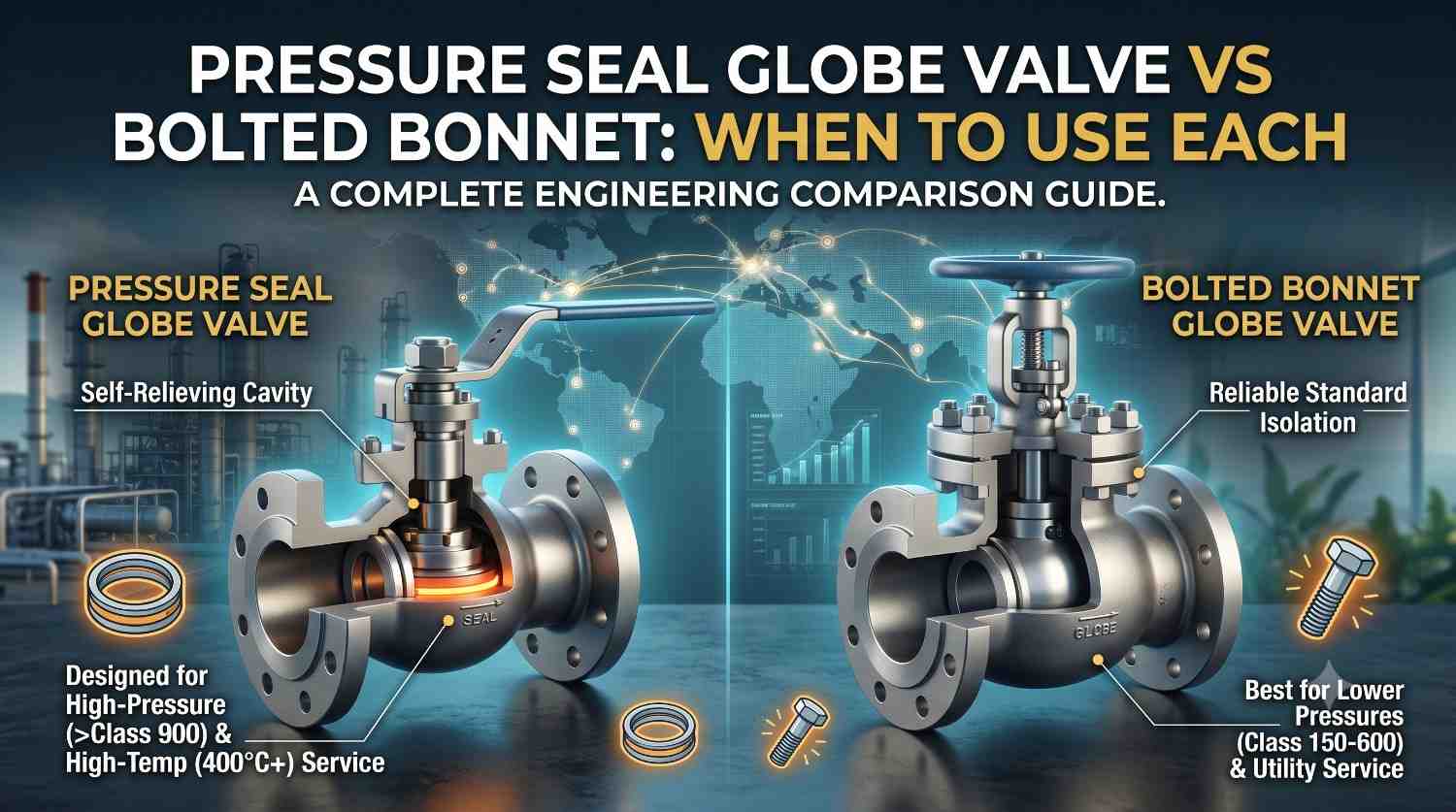
A bolted bonnet globe valve uses a bonnet that’s mechanically fastened to the valve body with a ring of bolts, with a gasket compressed between the two flanges to create the seal. It’s the more familiar, conventional design, and it’s been the default for general industrial service for decades.
A pressure seal globe valve works differently. Instead of relying on bolt tension alone to maintain the seal, the bonnet is held in place by the internal system pressure itself — the bonnet sits in a recess in the body, and a seal ring (often a flexible or self-energizing type) is compressed by a segmented retaining ring as pressure increases. In simple terms: the higher the internal pressure, the tighter the seal becomes. This is the opposite relationship of a bolted bonnet, where rising pressure works against the joint rather than reinforcing it.
This single structural difference is the reason the two designs end up suited to very different service conditions.
Pressure-Temperature Range: Where Each Design Holds Up
Bolted bonnet globe valves are well suited to low and moderate pressure-temperature applications — general process piping, water systems, and many standard industrial duties where pressures stay within moderate ANSI/ASME class ratings. As pressure and temperature climb, though, bolt tension becomes harder to maintain reliably. Thermal cycling can loosen bolts over time, and at extreme pressures, the bolt circle and flange thickness required to maintain an adequate seal start to make the valve bulky, heavy, and expensive.
Pressure seal globe valves are built for exactly the conditions where bolted bonnets start to struggle — typically ASME Class 600 and above, and especially in high-temperature steam service common in thermal and power generation plants. Because the sealing mechanism is self-energizing, the design actually becomes more reliable as pressure increases, rather than less. This is why pressure seal bonnets are the standard choice in main steam lines, feedwater systems, and other critical high-pressure circuits in power plants.
Maintenance and Field Considerations
Bolted bonnet valves are generally simpler and faster to maintain. Removing the bonnet is a matter of unbolting the flange, and most maintenance teams are already familiar with the process from working on similar valves across a plant. Gasket replacement is straightforward, and spare parts tend to be more readily available across a broader range of manufacturers.
Pressure seal valves require more specialized handling. Disassembly involves working with the segmented retaining ring and seal ring correctly, and reassembly needs to be done with attention to proper seating — a poorly reassembled pressure seal joint can leak even though the design is fundamentally more robust than a bolted bonnet under pressure. That said, in practice, pressure seal valves often need less frequent bonnet maintenance precisely because the seal improves rather than degrades under the operating pressures they’re designed for. The trade-off is technical complexity in exchange for fewer interventions over the valve’s service life.
Cost and Sizing Trade-offs
For lower pressure classes, bolted bonnet valves are typically the more economical option — both in upfront cost and in the broader availability of replacement parts and field expertise. As pressure class rises, though, the body and flange thickness needed for a bolted bonnet to hold a reliable seal grows substantially, and at some point the economics flip: a pressure seal design becomes more practical, more compact, and often more cost-effective than an oversized bolted bonnet attempting to do the same job at high pressure.
This is part of why pressure seal bonnets aren’t typically seen on lower-pressure general service valves — the design’s advantages only really pay off once pressure and temperature reach the range where bolted bonnets become structurally inefficient.
A Practical Way to Decide
A few questions tend to settle most specification decisions:
What’s the ASME pressure class? Below roughly Class 600, bolted bonnet is usually the simpler and more economical choice. At Class 600 and above, particularly in steam or other high-temperature service, pressure seal designs start to make more sense.
What’s the operating temperature? High-temperature steam service, especially with significant thermal cycling, favors pressure seal bonnets because bolt-tension-dependent joints are more vulnerable to loosening under repeated thermal expansion and contraction.
How critical is the line, and what’s the cost of unplanned downtime? In power plant main steam or feedwater applications, where an unplanned bonnet leak can mean a forced outage, the added reliability of a pressure seal design often justifies the higher upfront cost and more specialized maintenance requirements.
What maintenance expertise is available on-site? If a plant’s maintenance team has limited experience with pressure seal assemblies, that’s worth factoring in—not as a reason to avoid the design where it’s genuinely needed, but as a reason to plan for proper training or manufacturer support during commissioning and future maintenance.
Final Thoughts
Neither design is universally “better”—they’re suited to different points on the pressure-temperature spectrum, and the right choice comes down to matching the bonnet design to the actual service conditions rather than defaulting to whichever option is more familiar. For general industrial and lower-pressure process applications, a bolted bonnet globe valve remains a reliable, cost-effective, and easy-to-maintain choice. For high-pressure, high-temperature service — particularly the steam and feedwater systems found in power plants — a pressure seal globe valve is generally the safer long-term specification, even with its added maintenance complexity. Getting this decision right at the specification stage avoids a much more expensive correction later, after a valve has already been installed in a line it was never quite built for.