
For a long time, imported valves had a certain status in Indian industrial procurement. European brands especially. If a project spec said “imported valve preferred,” nobody questioned it much. The assumption was simple — foreign-made meant better quality, better documentation, and longer life. Domestic manufacturers existed, sure, but they were seen as the budget option. The backup plan.
That assumption is breaking down. Quietly, steadily, and in ways that are becoming harder to ignore.
Walk through procurement departments in Gujarat’s chemical belt today and you’ll find engineers who are actively choosing Indian butterfly valve manufacturers — not because the imported option isn’t available, but because after careful comparison, the domestic product is winning on more than just price. That’s a different conversation than the one this industry was having ten years ago.
So what actually changed?
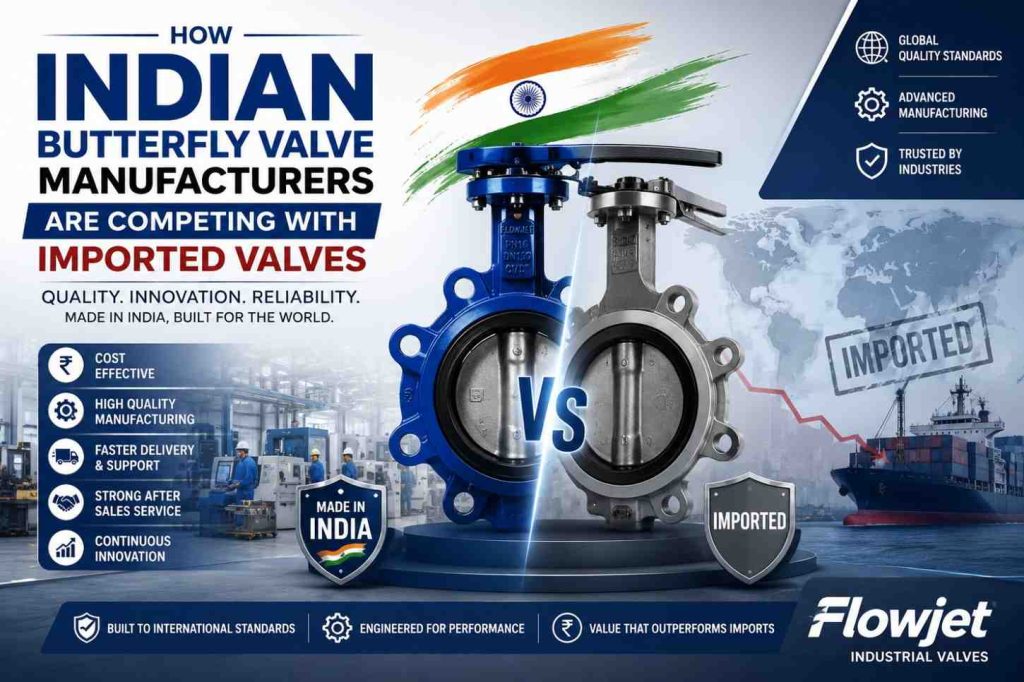
The Quality Gap Closed — And Then Some
The honest version of the old story is this: for a while, the quality gap between Indian and imported butterfly valves was real. Not in every case, but in enough cases that the bias toward imports made some sense. Material inconsistency, dimensional variation, documentation that didn’t hold up during audits — these were genuine complaints.
But that was a different era of Indian manufacturing. The butterfly valve manufacturers who survived and scaled through that period did so by getting serious about quality — not just claiming it, but building systems around it. ISO certification. In-house testing labs. Traceable raw material sourcing. Consistent machining tolerances.
Flowjet Valves is a good example of what this looks like in practice. Based in Ahmedabad, they’ve built their reputation across Gujarat’s process industries precisely because their product quality holds up — not against a low bar, but against the same performance expectations that imported valves are held to. Plant engineers who’ve run both side by side in similar service conditions are often the ones most surprised by how small the performance gap actually is. Sometimes it doesn’t exist at all.
Lead Times That Make Sense for Indian Projects
Here’s something that import-heavy procurement doesn’t talk about enough: the lead time problem.
An imported butterfly valve from a European or Chinese manufacturer involves an ordering cycle. Transit time. Customs clearance. Freight forwarding. Any quality issue discovered on arrival means the whole cycle starts again from somewhere in the middle. For a project running on a tight commissioning schedule, or a plant that needs a valve replaced urgently during a shutdown window, that supply chain is a liability.
An Indian butterfly valve manufacturer — particularly one located in an industrial hub like Ahmedabad’s GIDC belt — operates on a completely different timeline. Standard sizes from stock can be delivered the same day or next day within the state. Even custom configurations move faster when the manufacturing facility is a short drive away rather than a container ship and a customs queue away.
Flowjet Valves has structured its supply operations around exactly this kind of responsiveness. Gujarat-based buyers — and increasingly buyers from Maharashtra, Rajasthan, and beyond — have started factoring this lead time reality into total cost calculations. When you add the freight, the wait, and the risk of supply disruption to the imported valve’s unit cost, the equation shifts more than most import-preference buyers expect.
Documentation That Actually Works for Indian Standards
This is a subtler point, but an important one.
Indian projects — whether EPC contracts, government infrastructure tenders, or private industrial plant specifications — have documentation requirements that are increasingly specific. IS standards compliance. Material test certificates in a format that matches the project’s QMS template. Test reports that a local auditor can verify against recognisable benchmarks.
Imported valve documentation doesn’t always translate cleanly into Indian project requirements. Formats differ. Reference standards differ. Getting a European manufacturer to issue supplementary documentation to satisfy an Indian audit requirement is possible — but it’s a process, and it adds time and friction that nobody budgeted for.
Indian butterfly valve manufacturers who know the local market — and Flowjet Valves is one of them — produce documentation that’s already aligned with how Indian procurement, inspection, and project handover actually works. That’s not a small thing when you’re managing a project with hundreds of line items and a commissioning deadline.
The Customisation Advantage
Imported valves come in standard configurations. If what you need matches the catalogue, fine. If it doesn’t — a non-standard face-to-face dimension, a specific seat material combination, an actuation configuration that doesn’t match the stocked options — you either compromise on the specification or wait for a custom order with a premium lead time and a premium price.
Indian butterfly valve manufacturers with genuine in-house manufacturing capability don’t have this limitation to the same degree. Flowjet Valves, for instance, can accommodate customised seat material combinations, specific dimensional requirements, and tailored actuated configurations without the extended lead times that a foreign manufacturer’s custom order would involve — because the manufacturing decisions happen on their floor, not through a distributor chain.
For plant engineers specifying valves for specific process conditions rather than standard utility service, this flexibility matters.
The Spare Parts Reality
Buy an imported butterfly valve and at some point — a year later, three years later — you’ll need a replacement seat. Or a disc. Or a stem seal. And at that point you’ll find out what your supply chain actually looks like when it’s not backed by the urgency of a new project order.
Indian butterfly valve manufacturers solve this in a way that imported valve suppliers simply cannot match on geography alone. Spare parts sourced locally, from the original manufacturer, without minimum order quantities designed for bulk purchasing. Flowjet Valves supplies spare components for their valves as a standard service — which is the kind of after-sales reality that adds up over a valve’s operational life in a way that no upfront price comparison captures.
What This Means for Buyers
The choice between Indian and imported butterfly valves used to be a fairly simple trade-off: domestic for price, imported for confidence. That trade-off no longer describes the actual market.
Indian butterfly valve manufacturers — and Flowjet Valves in particular — have earned a position in serious industrial procurement not by being the cheapest option, but by being the most practical one. Quality that performs. Documentation that works. Lead times that suit Indian project realities. Spare parts without a supply chain adventure.
The buyers who’ve made the shift aren’t looking back. And the ones still defaulting to imported valves on habit rather than evidence are increasingly being asked by their own finance and operations teams to explain why.