
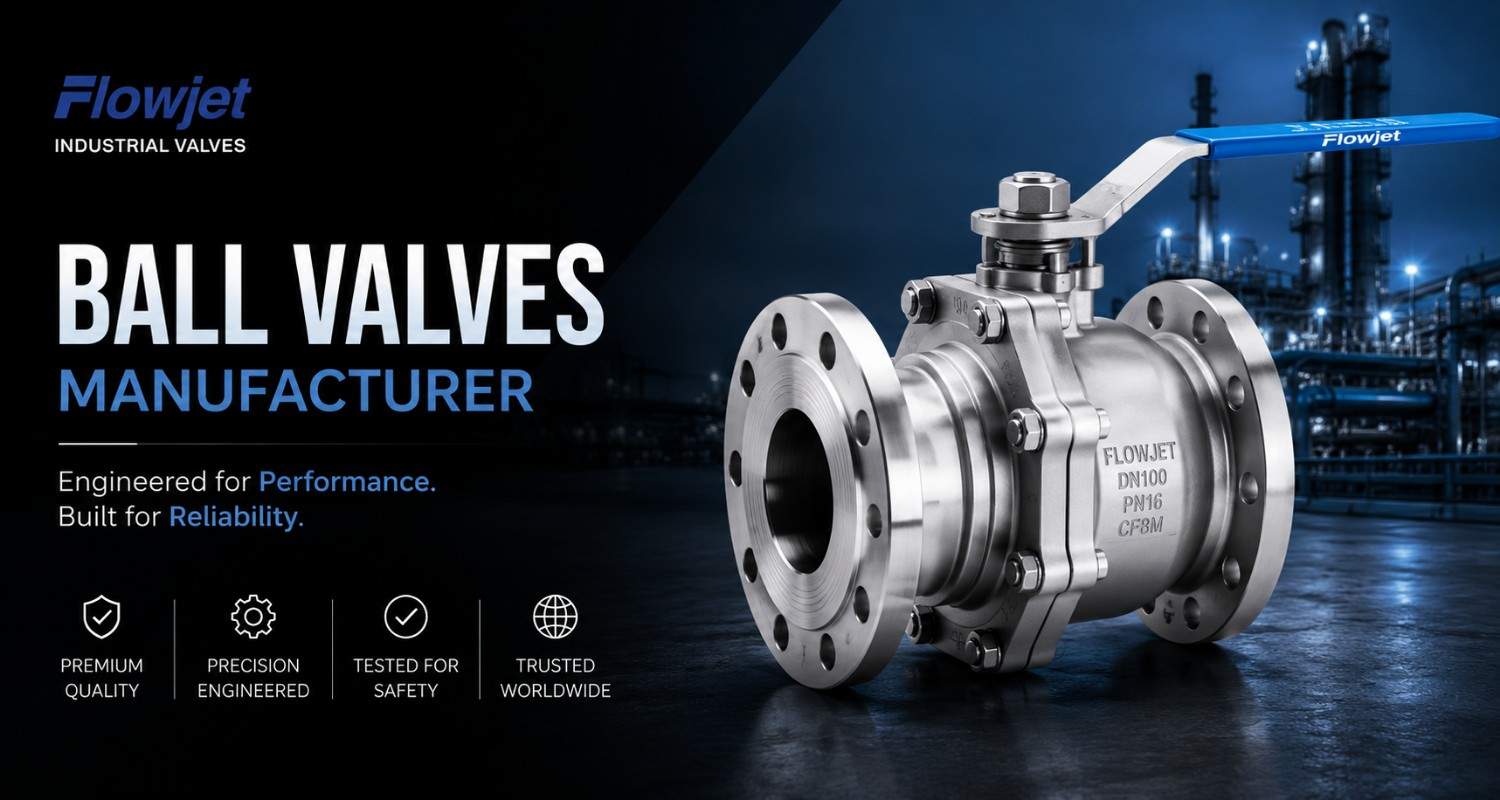
Leading Ball Valve Manufacturers in Ahmedabad– Flowjet Valve
Flowjet Valve is an industrial ball valve manufacturer based in GIDC Kathwada, Ahmedabad, Gujarat. We manufacture floating ball valves, trunnion mounted ball valves, fully welded ball valves, and 3-piece ball valves for process industries across India.
Every ball valve we manufacture is tested before dispatch. Hydrostatic shell testing. Seat leak testing. Dimensional inspection. Material test certificates are included with every order — not available on request after delivery. Standard from day one.
We supply to chemical plants, oil and gas facilities, pharmaceutical manufacturers, water treatment projects, power plants, and general process industries. If you need a ball valve that’s correctly specified, properly tested, and supported after delivery — request a quote today.
Our Ball Valve Product Range
We manufacture four main configurations of industrial ball valves. Each design suits different pressure, temperature, and service requirements.
Floating Ball Valve
The floating ball valve is the most widely used configuration in general process and industrial service.
In a floating design, the ball is held in position by two seats but is free to float slightly. Under line pressure, the ball is pushed against the downstream seat, creating a tight seal. This design delivers reliable shutoff across a wide range of service conditions.
Floating ball valves work best in low to medium pressure applications. At very high pressures or large bore sizes, the seating load on the downstream seat becomes excessive — which is where trunnion mounted designs take over.
Trunnion Mounted Ball Valve
Trunnion mounted ball valves have the ball supported at both the top and bottom by trunnion bearings — rather than floating freely between the seats. The seats are spring-loaded against the ball.
This design solves the high seating load problem of floating designs at large bore sizes and high pressures. The ball doesn’t need to float against the downstream seat. The spring-loaded seats maintain sealing contact regardless of line pressure. Operating torque stays consistent and manageable even in large sizes.
Trunnion mounted ball valves are the standard choice for pipeline service, oil and gas, and high-pressure process applications
Fully Welded Ball Valve
Fully welded ball valves have no external body joints or flanges. The body is welded into a single sealed unit around the ball and seats. There’s no possibility of external leakage from body bolts or gaskets — because neither exists.
This design is the correct choice for pipeline burial service, district heating and cooling networks, and high-pressure gas transmission where external leakage cannot be tolerated and the valve will not require in-line disassembly for maintenance.
3-Piece Ball Valve
The 3-piece ball valve has a body made of three separate sections — two end pieces and a central body — held together by studs and nuts. This allows the valve to be disassembled from the pipeline without removing the end pieces from the piping. The centre section lifts out for inspection, cleaning, or seat replacement.
For maintenance-intensive applications — food and beverage, pharmaceutical, sanitary processing, and any service where frequent cleaning or component inspection is needed — the 3-piece design is far more practical than a conventional one-piece or two-piece body.
Ball Valve Materials — Choosing the Right Grade for Your Application
Material selection determines how long a ball valve lasts in service. A valve that’s correctly specified for the process fluid works for years without trouble. A valve with the wrong material fails within months.
Here’s what we supply and when each material suits.
BODY MATERIALS:
Carbon steel (WCB / A216): General process service, oil and gas, steam, water. Temperature range: -29°C to 425°C. The default choice for most industrial applications.
Low-temperature carbon steel (LCB / LCC): Cold service below -29°C where standard carbon steel loses impact toughness. Cold climate installations, refrigeration, and cryogenic adjacent service.
Chrome-moly steel (WC6 / WC9): Elevated temperature process service above the range of standard carbon steel. Refinery hot service, steam at high pressure and temperature.
Stainless steel SS 304 (CF8): Food, pharmaceutical, mildly corrosive environments. Oxidation resistant. Not suitable for chloride-rich fluids.
Stainless steel SS 316 (CF8M): Aggressive chemical service, seawater-adjacent, chloride-bearing process fluids. Better corrosion resistance than SS 304.
Duplex / Super Duplex stainless: Highly corrosive service, offshore, high-chloride environments where SS 316 is insufficient.
SEAT MATERIALS:
PTFE: The standard seat material for general service. Good chemical resistance. Temperature limit approximately 180°C.
RTFE (Reinforced PTFE): Glass or carbon-fibre filled PTFE. Better mechanical strength and wear resistance than virgin PTFE. Handles more demanding throttling service.
Nylon (PA): Good wear resistance in abrasive service. Lower chemical resistance than PTFE.
Metal-to-metal (with Stellite): For high-temperature service, erosive media, and applications where soft seats would degrade. Required in fire-safe designs.
If you’re uncertain which material grade suits your process condition — provide the fluid name, concentration, and operating temperature when you enquire. Flowjet Valve’s technical team in Ahmedabad will confirm the correct specification before issuing a quote.
Ball Valve Specifications at a Glance
| Parameter | Details |
|---|---|
| Valve types | Floating, Trunnion, Fully Welded, 3-Piece |
| Size range | DN 15 to DN 600 (½” to 24″) |
| Pressure class | Class 150 to Class 2500 (ASME) / PN 16 to PN 420 |
| Body materials | WCB, LCB, WC6, CF8, CF8M, Duplex SS |
| Seat materials | PTFE, RTFE, Nylon, Metal-to-metal (Stellite) |
| End connections | Flanged, BW, SW, Screwed, Wafer |
| Operation | Manual lever, gear, pneumatic, electric actuated |
| Fire-safe | API 607 / API 6FA on request |
| Sour service | NACE MR0175 / ISO 15156 on request |
| Testing standard | API 598 |
| Documentation | MTC, hydrostatic test report, seat-leak report |
Industries We Serve
Ball valves from Flowjet Valve are used across Gujarat’s major process industries and across India.Lorem ipsum dolor sit amet, consectetur adipiscing elit. Ut elit tellus, luctus nec ullamcorper mattis, pulvinar dapibus leo.
CHEMICAL AND PETROCHEMICAL: Gujarat’s chemical clusters — Vatva, Naroda, Ankleshwar, Vapi, Dahej — are among our most active supply regions. Chemical feed lines, cooling water systems, solvent transfer, effluent treatment. We supply correct material combinations for the specific chemical environment, not just standard configurations that work for water.
OIL AND GAS: Floating and trunnion mounted ball valves for upstream, midstream, and downstream oil and gas service. API 6D compliant designs, fire-safe configurations, and NACE-compliant materials for sour service are all available on request.
PHARMACEUTICAL MANUFACTURING: 3-piece and hygienic ball valves in SS 316L for pharmaceutical process lines. Full material traceability, surface finish documentation, and clean-design configurations for regulated manufacturing environments.
Testing and Quality at Our Ahmedabad Facilit
Every ball valve that leaves our GIDC Kathwada facility has been tested. This isn’t a quality claim — it’s a process.
HYDROSTATIC SHELL TEST: Confirms body integrity under pressure. Conducted at 1.5 times the rated working pressure. Every valve. Every batch.
SEAT LEAK TEST: Confirms shutoff performance in both directions. Conducted at 1.1 times the rated working pressure. Results recorded for every unit.
DIMENSIONAL INSPECTION: Face-to-face dimensions, flange drilling, and bore concentricity checked against ASME B16.5 and relevant Indian standards.
MATERIAL VERIFICATION: Body material verified against purchase specification. Material test certificates retained for every batch. These ship with the valve — not available on request after delivery.
For projects requiring third-party witnessed testing, positive material identification (PMI), or radiographic examination of castings, these can be arranged at the time of order — not as an afterthought.
Why Procurement Teams Choose Flowjet Valve
Not every company that calls itself a ball valve manufacturer actually manufactures. Some buy components from multiple sources and assemble them. The product looks similar on paper. It behaves differently in service.
Here’s what makes Flowjet Valve different.
IN-HOUSE MANUFACTURING: We machine and assemble at our GIDC Kathwada, Ahmedabad facility. We don’t outsource critical processes to job shops. This means dimensional consistency, genuine material traceability, and the ability to accommodate non-standard configurations without extended lead times.
DOCUMENTATION THAT SHIPS WITH THE VALVE: MTC, hydrostatic test report, seat-leak test report. Included as standard. Not chased after delivery. Plant engineers and QA teams across Gujarat know this matters when an audit happens.
MATERIAL SELECTION SUPPORT: We review your service conditions before confirming a product. Wrong material recommendations get caught at the enquiry stage — not six months into service.
AHMEDABAD LOCATION: For Gujarat-based buyers, this means faster delivery on standard sizes, accessible spare parts from stock, and a factory you can actually visit before qualifying us as a vendor. That visit option matters more than most buyers realise until they try to arrange one with a distant supplier.
AFTER-SALES: Spare seats, stem seals, and body O-rings for our standard range are available from stock. A maintenance requirement doesn’t mean a new procurement cycle.
Frequently Asked Questions
Q: What types of ball valves does Flowjet Valve manufacture?
A: Flowjet Valve manufactures floating ball valves, trunnion mounted ball valves, fully welded ball valves, and 3-piece ball valves. All four configurations are available in multiple materials and pressure classes to suit different process industry applications.
Q: What sizes of ball valves are available?
A: Our ball valve range covers DN 15 to DN 600 (½” to 24″). Standard sizes in common configurations are available from stock. Larger sizes and non-standard configurations are manufactured to order.
Q: What pressure class ball valves does Flowjet Valve supply?
A: We supply ball valves in ASME pressure classes from Class 150 to Class 2500. The correct pressure class depends on your operating pressure and temperature — the pressure capacity of each class varies with temperature and body material. Our technical team can confirm the right class for your specific service condition.
Q: Do you supply fire-safe ball valves?
A: Yes. Fire-safe ball valves to API 607 and API 6FA are available on request. These are specified for hydrocarbon service applications where fire exposure is a design consideration.
Q: Do you supply ball valves for sour service?
A: Yes. Ball valves manufactured to NACE MR0175 / ISO 15156 requirements for hydrogen sulphide (H₂S) service are available. NACE compliance affects material grade selection and heat treatment — these must be specified at the time of order.
Q: What documentation comes with a ball valve order?
A: Every order includes material test certificates for body and critical components, hydrostatic shell test records, and seat-leak test reports. These ship with the valve as standard documentation. Third-party inspection, PMI, and additional certification can be arranged at the time of order.
Q: Can I get actuated ball valves from Flowjet Valve?
A: Yes. Pneumatic and electric actuated ball valves are available as pre-assembled, function-tested packages. Both single-acting (spring return) and double-acting pneumatic configurations are supplied. Electric actuated versions are available in multiple voltage configurations for BMS or DCS integration.
Q: Where is Flowjet Valve located?
A: Flowjet Valve is located at Plot No. 519, Phase II, GIDC Kathwada, Ahmedabad — 382430, Gujarat, India. We supply ball valves across Gujarat, India, and for export applications internationally.