
Oil and gas is one of the most demanding environments a valve can operate in. Extreme pressures. High temperatures. Corrosive and erosive media. Process lines where a valve failure isn’t just a maintenance inconvenience — it’s a safety incident, a production loss, or both.
Globe valves have served this industry for a long time. They’re not the newest technology. They don’t have the compact elegance of a ball valve or the large-diameter economy of a butterfly valve. But in the specific applications where precise throttling, reliable shutoff, and pressure integrity under demanding conditions matter most, globe valves remain the engineering choice that experienced process designers keep coming back to.
This guide covers everything an engineer or procurement professional needs to know about globe valve applications in oil and gas — the types, the standards that govern them, the materials that suit different service conditions, and the selection criteria that separate a valve that works from one that causes problems.
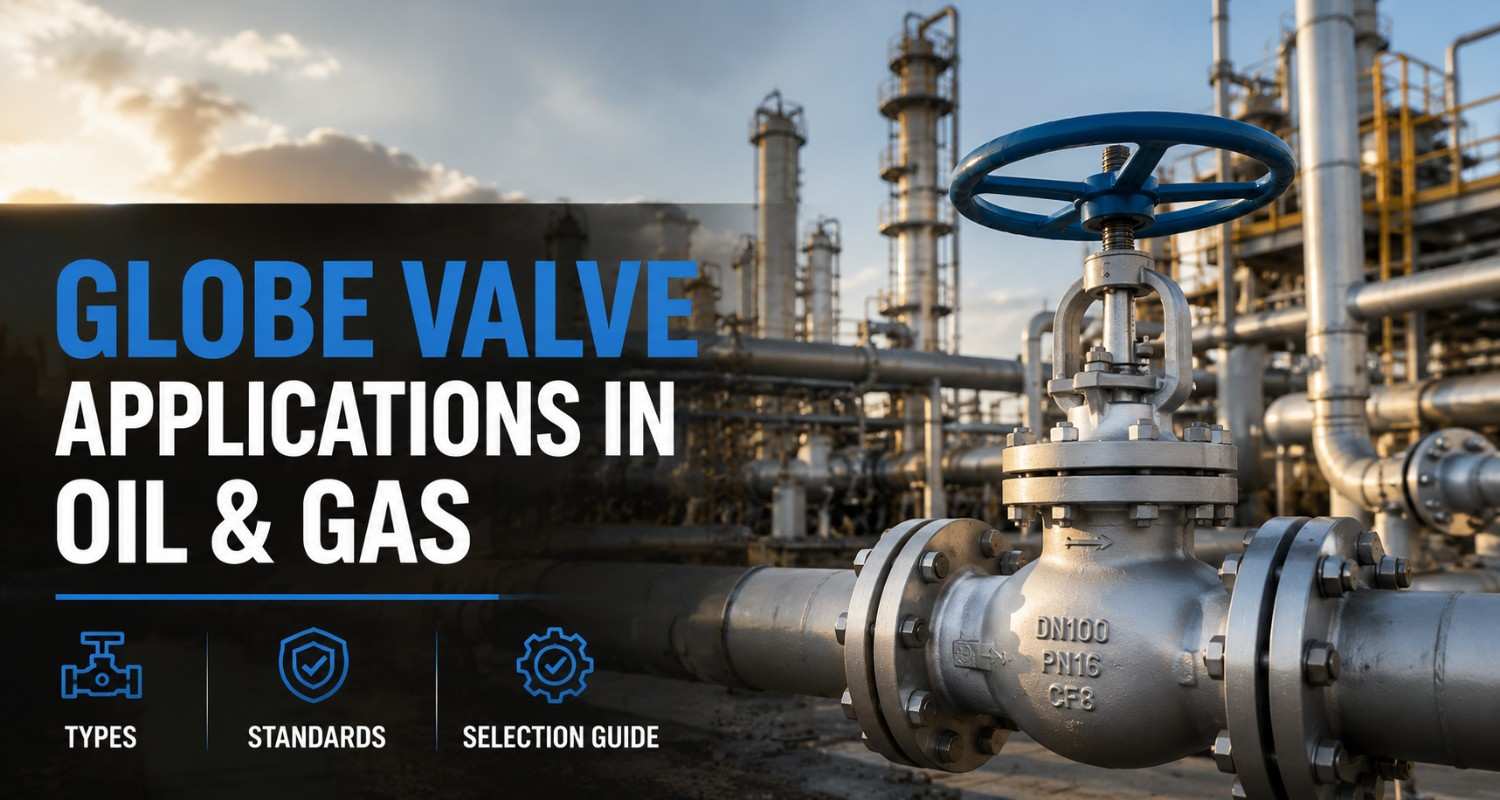
Why Globe Valves Are Used in Oil & Gas
Before getting into types and standards, it’s worth understanding why globe valves hold their position in oil and gas applications when other valve types are available.
The fundamental advantage of a globe valve is controllability. The disc moves linearly against a seat, and the relationship between stem travel and flow rate is more linear and predictable than a ball or gate valve. In throttling service — where the valve spends most of its life at partial opening rather than fully open or fully closed — this matters enormously. A ball valve throttles poorly. A gate valve throttles poorly and wears its seats rapidly in partial-open positions. A globe valve is designed for exactly this duty.
The second advantage is tightness. Globe valves achieve reliable shutoff because the disc presses firmly against the seat in the closed position, driven by stem force rather than relying on a floating seal under pressure. In critical process lines where any passing through a closed valve is unacceptable, this seating mechanism is preferred.
The third advantage is repairability. Globe valves can be overhauled in-line. The bonnet can be removed, the disc and seat inspected, and both can be replaced or lapped without removing the valve from the pipeline. In a refinery or offshore platform where pipeline removal means extended downtime, this is a significant operational benefit.
None of these advantages makes globe valves the right choice for every oil and gas application. Large diameter flow control, full-bore pig-passing requirements, and cryogenic service all point to other valve types. But in the applications where globe valves are specified, they’re there for good reasons.
Types of Globe Valves Used in Oil & Gas
1. Standard (Straight Pattern) Globe Valve
The most common configuration. The flow path passes through the valve body in a Z-shaped route — entering below the seat, passing through the disc-seat interface, and exiting above it. This configuration creates a higher pressure drop than other valve types, which is acceptable in control and throttling service where pressure drop is expected and sometimes desirable.
Typical oil and gas applications: Steam service on utility lines, general process throttling, pressure control stations, cooling water control.
2. Angle Globe Valve
The inlet and outlet are at 90 degrees to each other rather than in a straight line. This reduces the number of turns in the flow path and lowers pressure drop compared to the straight pattern. It also simplifies piping layouts in certain configurations.
Typical oil and gas applications: Boiler feed and blowdown service, process lines where the piping naturally turns 90 degrees, condensate control.
3. Y-Pattern Globe Valve
The seat and stem are set at an angle to the pipeline axis — typically around 45 degrees. This creates a more streamlined flow path than the Z-pattern, significantly reducing pressure drop while retaining the globe valve’s throttling and shutoff characteristics.
Typical oil and gas applications: High-pressure service where pressure drop is a concern, pipeline service, feedwater and injection lines where flow efficiency matters.
4. Needle Globe Valve
Uses a long, tapered needle-shaped plug instead of a flat or rounded disc. This gives extremely fine flow control at low flow rates.
Typical oil and gas applications: Instrument air lines, sample connections, chemical injection systems, flow calibration and metering applications.
5. Pressure Seal Globe Valve
A design specifically built for high-pressure, high-temperature service. Instead of relying on bolt tension to hold the bonnet seal, the pressure seal design uses the internal process pressure itself to energise the seal — the higher the pressure, the tighter the bonnet joint becomes.
Typical oil and gas applications: Main steam lines in power generation within oil and gas facilities, high-pressure feedwater systems, refinery high-pressure process service. Standard choice for ASME Class 600 and above.
6. Bellows Seal Globe Valve
Uses a metal bellows to provide a secondary stem seal, eliminating fugitive emissions from the packing area. The bellows is welded to both the stem and the valve body, creating a hermetically sealed stem passage.
Typical oil and gas applications: Toxic gas service, highly volatile hydrocarbons, applications where zero fugitive emissions are a regulatory or safety requirement. Increasingly specified in response to tightening VOC emission regulations.
7. Cryogenic Globe Valve
Extended bonnet design that keeps the packing and stem seal away from the cold service temperature. Prevents packing from freezing and maintains seal integrity in low-temperature applications.
Typical oil and gas applications: LNG service, liquid nitrogen, ethylene, and other cryogenic hydrocarbon processing.
Key Standards Governing Globe Valves in Oil & Gas
Standards are not optional in oil and gas valve procurement. They define dimensional compatibility, pressure-temperature ratings, material requirements, and testing protocols. A globe valve that doesn’t conform to the relevant standards creates problems at fabrication, inspection, and project handover.
API 623 — Steel Globe Valves for Petroleum, Chemical, and Related Industries
The primary globe valve standard for oil and gas applications. API 623 covers flanged and butt-welding end globe valves in sizes NPS ½ through NPS 24, in pressure classes 150 through 2500. It specifies material requirements, wall thickness calculations, end-to-end dimensions, test requirements, and marking.
Any globe valve going into an oil and gas facility should be checked for API 623 compliance unless a project specification explicitly calls for a different standard.
ASME B16.34 — Valves — Flanged, Threaded, and Welding End
Covers the pressure-temperature ratings for steel valves across all classes. API 623 references ASME B16.34 for pressure-temperature ratings. If a globe valve is rated to a specific pressure class, that rating is defined by ASME B16.34 for the corresponding material group.
API 598 — Valve Inspection and Testing
Defines the test procedures and acceptance criteria for valve shell tests, seat leak tests, and back seat tests. A globe valve described as “API 598 tested” has undergone specific pressure testing with defined maximum allowable leakage rates for the seat and shell.
For oil and gas applications, API 598 test documentation is typically required at project handover and inspections.
ASME B16.10 — Face-to-Face and End-to-End Dimensions
Defines the physical dimensions between valve end connections. Compliance with ASME B16.10 ensures that a globe valve will fit directly into a piping system designed to the same standard, without modification. Important for interchangeability during maintenance and replacement.
ISO 17292 — Metal Ball Valves (and ISO 10631 for Globe Valves)
ISO standards are referenced in international projects and EPC contracts with European or multinational clients. Globe valves conforming to ISO 10631 meet dimensional and performance requirements aligned with international project specifications.
NACE MR0175 / ISO 15156 — Sour Service Requirements
In oil and gas service involving hydrogen sulphide (H₂S), valve materials must meet the requirements of NACE MR0175 (now ISO 15156) to prevent sulphide stress cracking. Globe valves for sour service require specific material grades and heat treatment conditions. This is not a dimensional or performance standard — it’s a material qualification standard that affects which alloys can be used in the valve body, trim, and sealing components.
Any globe valve going into sour service must have NACE-compliant material documentation. This is non-negotiable.
TA-Luft / VDI 2440 — Fugitive Emissions Standards
European and international projects increasingly specify fugitive emission requirements for valves in hydrocarbon service. TA-Luft compliance (a German technical regulation that has become an international benchmark) requires valves to demonstrate low fugitive emissions from the stem seal during type testing.
For offshore and onshore hydrocarbon service in export-oriented projects, this is becoming a standard specification requirement rather than an optional extra.
Material Selection for Globe Valves in Oil & Gas
Material selection is where globe valve specification gets genuinely complex in oil and gas applications. The right material depends on the fluid being handled, the operating temperature and pressure, and any specific corrosion or erosion concerns.
Body and Bonnet Materials
Carbon Steel (ASTM A216 WCB) — The standard body material for general oil and gas service at moderate temperatures (up to approximately 425°C). Cost-effective, widely available, well-understood material for most refinery and pipeline applications.
Low-Temperature Carbon Steel (ASTM A352 LCB/LCC) — For service conditions below the impact toughness limit of standard carbon steel. Used in cold climate installations, cryogenic adjacent service, and refrigeration applications.
Chrome-Moly Steel (ASTM A217 WC6, WC9, C12A) — For elevated temperature service, particularly steam and hot process service. WC6 (1.25% Cr, 0.5% Mo) suits service up to approximately 540°C. WC9 and C12A extend the temperature range further. Common in refineries and process heater outlet piping.
Stainless Steel (CF8M — equivalent to SS 316) — For corrosive service, seawater injection, chemical injection, and applications where carbon steel would corrode. Higher cost but necessary where corrosion allowance calculations don’t support carbon steel.
Duplex and Super Duplex Stainless Steel — For highly corrosive service, particularly chloride-containing environments like seawater injection and offshore production lines. Better corrosion resistance than standard stainless at lower cost than nickel alloys.
Inconel, Hastelloy, Monel — For extreme corrosive service, high-temperature aggressive environments, and applications where stainless steel isn’t sufficient. Specified for specific aggressive process streams in refineries and chemical plants within oil and gas complexes.
Trim Materials (Disc, Seat, Stem)
Trim refers to the internal wetted components — disc, seat ring, and stem. In oil and gas, trim selection is driven by the process fluid’s corrosivity, erosiveness, and temperature.
Hard-faced trim (Stellite overlay) — For erosive service, steam throttling, and applications where metal-to-metal seating is required. Stellite-faced seats and discs resist erosion and wear far better than uncoated steel.
13% Chrome steel trim — Cost-effective for moderately corrosive and moderate-temperature oil and gas service. Common in refinery general service globe valves.
316 Stainless trim — For corrosive service where carbon steel or 13% chrome isn’t sufficient. Standard specification in chemical injection and sour-adjacent service.
Inconel trim — For high-temperature oxidising environments and aggressive chemical service where stainless steel trim would corrode.
Globe Valve Selection Criteria for Oil & Gas Applications
Step 1: Define the Service Conditions
Before selecting any globe valve, the following must be known:
- Fluid type: Gas, liquid, vapour, two-phase, or slurry
- Operating pressure and temperature: Normal operating values and maximum anticipated values
- Fluid composition: Presence of H₂S (sour service), CO₂ (sweet or carbonic acid service), chlorides, or other corrosive species
- Flow rate and required Cv/Kv: To correctly size the valve for the throttling requirement
- Shutoff class required: Leakage class to API 598 or other standard
These parameters drive every subsequent selection decision.
Step 2: Determine the Pressure Class
ASME pressure classes run from Class 150 (approximately 20 bar at ambient) through Class 2500 (approximately 345 bar at ambient). The correct pressure class is determined by the maximum allowable working pressure at the operating temperature, using the ASME B16.34 pressure-temperature tables for the selected body material.
Undersizing the pressure class is a safety failure. Oversizing it adds unnecessary cost and weight. Getting it right requires checking the tables for the specific material at the specific temperature.
Step 3: Select the Globe Valve Type
Using the application characteristics and the valve type descriptions above:
- Throttling at moderate pressure: Straight pattern or Y-pattern globe valve
- High-pressure high-temperature service: Pressure seal globe valve
- Sour or toxic gas service: Bellows seal globe valve
- Fine control or instrument service: Needle globe valve
- Space-constrained or low-pressure-drop required: Y-pattern or angle globe valve
- Cryogenic service: Extended bonnet cryogenic globe valve
Step 4: Confirm Material Compatibility
Match the body and trim material to the service fluid using corrosion compatibility data and any applicable standards (NACE MR0175 for sour service, specific material restrictions in project specifications).
Step 5: Verify Standards Compliance
Confirm the selected valve conforms to API 623 (or the project-specified alternative), that testing will be conducted to API 598, and that any fugitive emission, cryogenic, or sour service requirements are documented in the purchase specification.
Step 6: Consider End Connection Type
Flanged connections (to ASME B16.5 for most pressure classes) suit most refinery and process plant applications. Butt-weld ends are preferred for high-pressure, high-temperature service where a flanged joint in the line is not acceptable. Socket weld ends suit smaller bore instrument and sample connections.
Common Globe Valve Failures in Oil & Gas — and How to Avoid Them
Seat Erosion in Throttling Service
Globe valves used in severe throttling service — where high differential pressure exists across a partially open valve — are prone to seat and disc erosion caused by the high-velocity fluid jet. The fix is either a correctly selected trim design (hardened trim, anti-cavitation trim, or multi-stage pressure drop design) or reviewing whether the valve is correctly sized and positioned for the application.
Stem Packing Fugitive Emissions
Stem packing degrades over time in high-temperature and high-cycling service. In hydrocarbon service, this creates a fugitive emission source. Specifying low-emission packing designs and considering bellows seal construction for the most sensitive applications prevents this from becoming a compliance issue.
Bonnet Gasket Leakage at High Temperature
In high-temperature service, bolted bonnet globe valves can experience bolted joint relaxation during thermal cycling, leading to bonnet gasket leakage. Pressure seal bonnet designs eliminate this failure mode by making the sealing force dependent on internal pressure rather than bolt tension.
Wrong Pressure Class for the Service
This is a specification failure, not a manufacturing one — but it results in field failures. Globe valves rated at a pressure class that seems adequate at ambient temperature may be de-rated to below the operating pressure at elevated temperature. Always check the pressure-temperature rating at the actual operating temperature, not just the nominal pressure class.
Flowjet Valve — Globe Valve Manufacturer for Oil & Gas and Process Industries
Flowjet Valve manufactures and supplies globe valves for process industries across India, including oil and gas adjacent applications in refineries, petrochemical plants, power generation within oil and gas complexes, and general heavy industry.
Based in Ahmedabad, Gujarat, Flowjet Valve’s product range covers:
- Standard (Z-pattern) globe valves in carbon steel, stainless steel, and alloy materials
- Y-pattern globe valves for high-pressure and pipeline service
- Pressure seal globe valves for high-pressure, high-temperature applications
- Bellows seal globe valves for fugitive emission-sensitive service
- Angle globe valves for condensate, blowdown, and specific piping configurations
All products are manufactured with material test certification, API 598 test capability, and documentation packages suited to industrial project handover requirements.
For engineering teams specifying globe valves for oil and gas or process industry applications, Flowjet Valve’s technical team can assist with pressure class selection, material compatibility, standards compliance, and documentation requirements — at the specification stage, not after a problem develops in the field.
Frequently Asked Questions
What is the difference between a gate valve and a globe valve in oil and gas?
Gate valves are designed for full-open or full-closed service with minimal flow restriction when open. Globe valves are designed for throttling and control service. In oil and gas, gate valves are used for isolation at pipeline block valve positions, while globe valves are used for flow control, pressure regulation, and throttling service.
What pressure class globe valve is used in high-pressure oil and gas service?
High-pressure oil and gas service typically requires Class 600, Class 900, Class 1500, or Class 2500 globe valves depending on the actual operating pressure and temperature. For Class 600 and above, pressure seal bonnet designs are generally preferred over bolted bonnets.
What does NACE compliant mean for a globe valve?
NACE compliant means the valve materials meet the requirements of NACE MR0175 / ISO 15156 for service in environments containing hydrogen sulphide. This requires specific material grades, hardness limits, and heat treatment to prevent sulphide stress cracking. It is mandatory for sour service applications.
What is a bellows seal globe valve used for?
Bellows seal globe valves are used in service where fugitive emissions from the stem seal are unacceptable — toxic gas lines, highly volatile hydrocarbons, and applications with strict VOC emission requirements. The metal bellows provides a hermetic seal around the stem.
Can globe valves be used for on/off service in oil and gas?
Yes, globe valves can be used for on/off service, though they’re better suited to throttling applications. For pure isolation service at large diameters, gate or ball valves are typically more economical. Globe valves are preferred for on/off service where tight shutoff is critical and the valve will be infrequently operated.
Final Thought
Globe valves in oil and gas service are not a commodity purchase. The range of types, the complexity of applicable standards, the material selection requirements, and the consequences of getting the specification wrong all point to the same conclusion: this is an engineering decision that requires genuine product knowledge, not just a catalogue selection.
The right globe valve for a high-pressure steam service in a refinery is a completely different product from the right globe valve for a chemical injection line or a condensate control application. The standards that apply differ. The materials differ. The trim design differs. The bonnet design may differ.
Working with a globe valve manufacturer who understands these distinctions — and who asks the right questions before confirming a supply — is what separates a procurement decision that works from one that creates problems.
Flowjet Valve is that manufacturer for India’s oil and gas, petrochemical, and process industries. The product range, the technical capability, and the documentation systems are built for the demands of serious industrial procurement.