
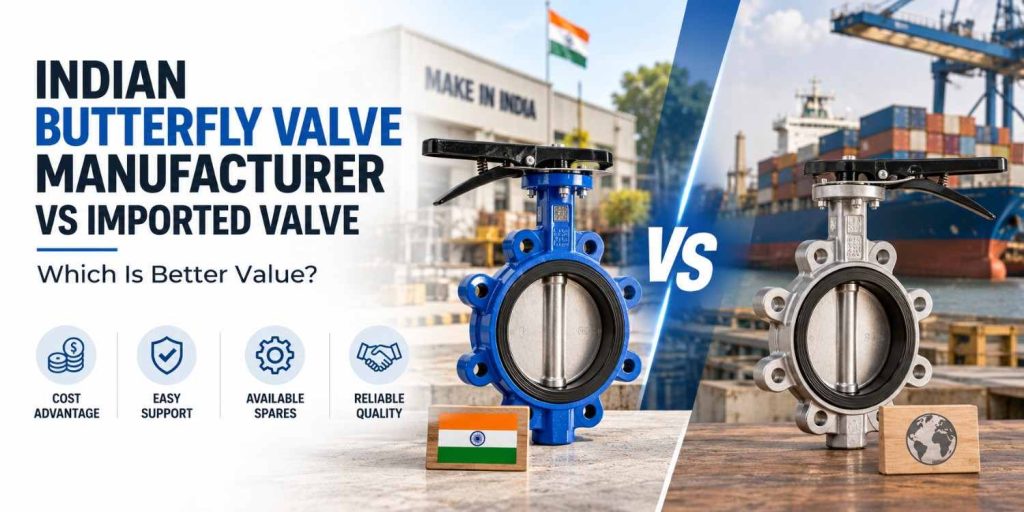
Two quotations are sitting on your desk. One is from an Indian butterfly valve manufacturer. The other is from an overseas brand with a glossy catalogue. The import is pricier, the local one is cheaper, and somebody in the room always asks the same thing: “But will it last?”
I’ve seen that conversation play out in purchase meetings more than once, and the honest answer is boring. It depends. But it depends on things you can actually check, so let’s go through them.
Price on the Quote Is Not What the Valve Costs
Most people compare the number at the bottom of the quotation and move on. That number is just the start.
A valve costs you its purchase price, plus freight, plus duty, plus the days you spend waiting for it, plus every hour of downtime when something wears out. Add the cost of getting a spare seat in a hurry and the picture changes. A valve that looked 15% cheaper on paper can end up being the expensive one, and the same is true the other way round.
So when someone asks which is better value, I ask them to look at ten years, not ten minutes.
Where Imported Butterfly Valves Do Well
Let me be fair first, because plenty of buyers get this wrong in the opposite direction and dismiss imports completely.
Some overseas manufacturers have been building valves for a very long time. They have field data going back decades, and for certain jobs that matters. Think high-temperature steam, unusual chemicals, or very tight shut-off requirements where the design itself is the product of years of research. Their paperwork is usually excellent too, which helps on projects with strict audits.
And sometimes the choice isn’t yours. If the client or consultant has written a specific foreign brand into the specification, that’s that. You supply what’s written.
But in my experience those situations are the exception. Most butterfly valves in India go into water lines, cooling circuits, HVAC, fire systems, food plants and general process piping. Ordinary duties. Nothing exotic.
What Imports Quietly Add to Your Bill
Here is the part that never appears in the brochure.
Landed cost. Freight, insurance, customs duty, clearing agent charges, port handling. Currency swings can eat into your budget between the day you order and the day you pay. By the time the valve reaches your gate, that “only 10% higher” quote has usually grown.
Waiting. Imported valves take weeks, sometimes months. A container held up at port or a missed shipping slot, and your pipeline sits half-finished. If you’re working toward a fixed shutdown window, that’s a real problem, not a theoretical one.
Spares. Seats and stems wear out. That’s normal. What isn’t normal is waiting three or four weeks for a rubber seat that costs a few hundred rupees because it has to come from another continent. Plants end up buying a whole extra valve “just in case,” which means paying twice.
Support. When something goes wrong at 2 a.m., you want to call someone who can be at your site tomorrow. Not send an email into a different time zone and hope.
What a Good Indian Manufacturer Brings
India’s valve industry has grown up a lot. Domestic manufacturers now supply water utilities, power plants, pharma units, food processing and chemical plants, and several export to the Middle East, Africa and Southeast Asia. That wouldn’t happen if the quality wasn’t there.
The price advantage is real, and it isn’t about cutting corners. Castings are sourced locally, labour and overheads are lower, and you aren’t paying for ocean freight and import duty. You’re paying for the valve.
Delivery is the next big difference. Standard sizes can often ship quickly, and even custom orders usually move faster than an import.
Then there’s flexibility. Need a different face-to-face dimension, special flange drilling, a particular seat material, or a mounting kit that fits your actuator? A local manufacturer will usually sit down with your drawing and sort it out, often without a huge minimum order. Big overseas suppliers tend to be less willing to bend on small quantities.
And spares. You call the factory, send a sketch, and the replacement is on a truck within days. For a plant that runs round the clock, that alone can justify the decision.
Reputable manufacturers here build to recognised standards such as API 609, EN 593 and ISO 5752, along with the relevant IS norms. Ask for the certificate. A good supplier will hand it over without fuss.
So Is an Indian Valve as Good as an Imported One?
A good one is. A bad one isn’t. And that’s equally true of imports.
I’ve seen poorly made valves with foreign nameplates, usually the very cheap ones from traders nobody can trace. I’ve also seen Indian valves that ran for years in punishing conditions without complaint. Country of origin tells you very little. The manufacturer tells you a lot.
So skip the “Indian or imported?” question and ask whether this particular supplier can prove what they claim. Look for:
- Material test certificates for the body, disc and stem
- Pressure test reports for each valve, not just a sample
- ISO 9001 certification, and any other approval your project needs
- Permission for you or a third-party inspector to visit the plant
- References from similar industries that you can actually call
- Warranty terms written in plain language
Anyone who gets defensive about these requests is telling you something. A confident manufacturer is happy to be checked.
A Realistic Example
Picture a plant fitting thirty-odd wafer type butterfly valves on a cooling water loop.
Go the import route and you pay the ex-works price, then freight, duty and clearing, then wait for the shipment. Go local and you pay one price and get a delivery date you can plan around.
Now fast-forward five years. A few seats have worn out. The local supplier sends replacements in days. The overseas one takes weeks and may charge a premium for urgent dispatch. Multiply that across thirty valves and several maintenance cycles, and the gap gets wide.
This is exactly why some procurement teams that started with imports purely for the brand have slowly moved to qualified domestic suppliers. Nobody sacrificed quality. They just stopped paying for delays.
Pick the Right Valve Type First
Here’s something that gets overlooked. Choosing the wrong type of valve costs more than choosing the wrong country, so get this part right.
A wafer type butterfly valve is compact and economical. It sits between two flanges and works well for water, air and general-purpose lines.
A lug type butterfly valve has threaded lugs, so you can use it for dead-end service or remove downstream piping without draining the whole line.
A double flanged butterfly valve suits bigger sizes and heavier duty, where you want a rigid, bolted connection on both sides.
A double offset butterfly valve reduces seat wear because the disc lifts away from the seat quickly as it opens. It copes with higher pressure and temperature than a basic concentric design.
Seat material matters just as much. EPDM is a sensible choice for water and many general fluids, NBR handles oils, and PTFE or Viton is what you reach for with aggressive chemicals. For the body, cast iron works for ordinary water service, ductile iron is tougher, and stainless steel is the answer for corrosive or hygienic environments.
For operation, a lever is fine for small sizes. Larger valves need a gear operator, and automated plants use pneumatic or electric actuators.
One practical tip: a trustworthy supplier will ask about your medium, pressure, temperature and how often the valve cycles before quoting anything. If someone sends a price without asking a single question, be careful.
When Imported Still Makes Sense
Choose an import when the project specification names an overseas brand, when your process is so specialised that no domestic maker has proven experience with it, or when your consultant or insurer insists on an international approval that a local option doesn’t yet hold. Those are valid reasons.
When an Indian Manufacturer Is the Smarter Choice
Go local when you want a lower landed cost without gambling on quality, when you need short and predictable delivery, when fast spares and responsive service matter, when your site needs custom dimensions or materials, or when you want a supplier who actually knows your plant over the long run.
Where Flowjet Valve Fits In
If you’re building a shortlist of domestic suppliers, Flowjet Valve is an Indian butterfly valve manufacturer worth a look. You can browse the range and specifications at flowjetvalve.com.
Don’t take our word for it, though. Ask for the datasheet, the test certificates and a couple of references, then compare them with your requirements. That’s how a careful buyer works, and we’d rather you did.
Six Questions to Ask Before You Sign the PO
- Have I compared landed cost, not just ex-works price?
- What’s the real delivery time, and what happens if it slips?
- Where do spare parts come from, and how fast?
- Are the test certificates and standards documented?
- Can the manufacturer adjust the valve if my site needs it?
- Is there a person I can call when something goes wrong?
If the Indian supplier answers those better than the overseas one, you have your decision.
The Bottom Line
The question was never really “Indian or imported.” It’s who gives you dependable performance, a fair price and support when you need it. For most industrial and municipal jobs, a reputable Indian butterfly valve manufacturer offers the best mix of cost, speed and service. Imports earn their place in specialised, specification-driven work.
Think about total cost over the life of the valve, check quality through documents instead of assumptions, and pick the partner who’ll still pick up the phone in five years.
FAQs
Are Indian butterfly valves as durable as imported ones?
A well-made valve from a certified manufacturer performs reliably in most applications. Durability comes down to materials, design and testing, not the country on the nameplate.
Is an Indian butterfly valve cheaper than an imported one?
Usually, yes. There’s no freight, duty or customs, and local production costs are lower.
Which standards should I look for?
API 609, EN 593, ISO 5752 and relevant IS norms are common benchmarks. Always ask for test certificates.
Can Indian manufacturers make custom butterfly valves?
Yes. Many offer custom sizes, materials, seat options and actuator mounting, often with shorter lead times than imports.
How do I choose between wafer and lug type?
Pick wafer for compact, economical installations. Pick lug when you need dead-end service or easier line maintenance.