
Run a high-pressure line, pull volatile gas across a country, or pump harsh chemicals through a refinery, and standard floating ball valves will give out fast. They just can’t take that kind of punishment. Once your operating pressures climb to Class 600, 1500, or 2500, field engineers and procurement teams stop looking at basic designs. Instead, they shift focus to heavy-duty, API 6D certified trunnion mounted ball valves.
Think about how a standard floating valve works: the ball drifts slightly downstream under load, smashing into the seat ring to force a seal. That is fine for low pressures, but it wrecks seats in severe service. Trunnion-mounted designs fix this by clamping the ball down at both ends with an upper stem and a rugged bottom pivot. This physical anchor takes the brutal hydraulic thrust off the line, keeping the core parts centered. The result? Your valve seats wear down much slower, turning torques drop like a rock, and you get an absolute, drop-tight shutoff even under extreme differential pressure spikes.
Because these assemblies handle volatile, dangerous, and high-velocity fluids every day, you cannot risk buying from unverified shops. This real-world guide breaks down the dominant global manufacturers of API 6D trunnion ball valves, highlights the core mechanical metrics you must evaluate, and looks at how Flowjet Valve matches up against the tier-1 majors on quality and turnaround.
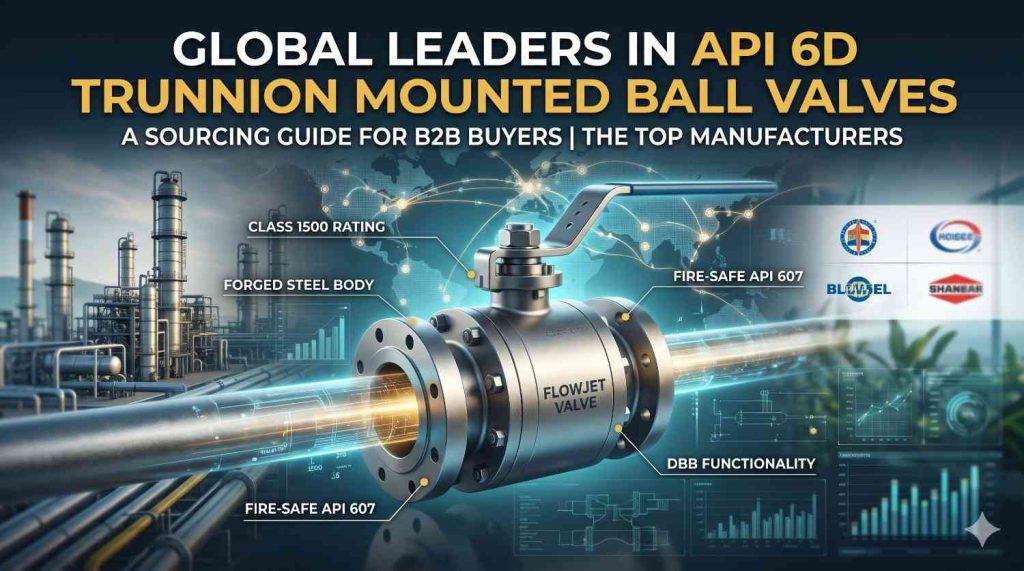
Why Does an API 6D Monogram Matter So Much on a Factory Floor?
When sourcing heavy equipment globally, you can’t just trust a basic catalog sheet. You need a hard quality standard. That is where the API 6D monogram (from the American Petroleum Institute) comes in. It sets the baseline rules for pipeline and process isolation hardware across the globe.
An authentic API 6D license isn’t a simple paperwork check. It forces a factory to build and test to relentless quality benchmarks, including:
- True Wall Thickness Boundaries: Ensuring the outer cast or forged steel shell won’t split or deform under immense hydrodynamic loads.
- Unrestricted Full Bore Flowpaths: Sizing the internal lines precisely so heavy pipeline pigs can pass through without getting jammed during maintenance runs.
- Rigorously Documented Testing: Forcing long holding times during hydrostatic shell tests and pneumatic seat checks to catch the tiniest pinpoint leaks before a valve leaves the building.
Experienced procurement agents always verify active API registry accounts before cutting a purchase order. It is the easiest way to avoid field failures and dangerous fugitive emission leaks.
The Major Players in the Global API 6D Trunnion Ball Valve Market
A few major conglomerates command a large presence on legacy engineering specs, but specialized, quick-turn factories are taking significant market share by delivering comparable precision without massive lead times.
1. Cameron (A Schlumberger Company)
Cameron is an old-school name in oilfield midstream hardware. Their GROVE and ORBIT product lines are standard sights on major custody transfer loops and cross-country gas links. They are known for fully welded bodies and top-entry models that handle massive pressure loads. The downside? You will typically face long, bureaucratic corporate wait times and premium price tags.
2. Flowserve Corporation
Flowserve runs a massive global network focused on industrial fluid motion. Their Valbart trunnion ball valve series handles severe process situations and extreme cryogenic services. They excel at advanced wear coatings—like Tungsten Carbide (TCC)—which keep metal-to-metal seats working in rough, sandy slurries without seizing up.
3. Emerson Automation Solutions
Emerson built a massive footprint by buying up legendary valve marks like Fisher, Vanessa, and the old Pentair brands. They specialize in highly complex, automated control loops. If you need a trunnion ball valve configured as an emergency shutdown valve (ESD) with advanced digital positioning smarts, their packages are common choices, though pricing reflects their enterprise overhead.
4. Velan Inc.
Operating out of Canada for decades, Velan builds high-grade forged and cast steel isolation valves. Their three-piece split body trunnion assemblies are built for brutal environments, working reliably in freezing arctic installations and high-temperature refining units alike.
5. L&T Valves
Part of the Larsen & Toubro group, this manufacturer operates with strict quality management frameworks. Their trunnion designs focus heavily on modern safety standards, offering ISO 15848-1 low-leakage certification and SIL 3 functional safety ratings for critical industrial plants.
6. Flowjet Valve: Balancing Tier-1 Engineering with Real-World Timelines
Right alongside these legacy multi-nationals, Flowjet Valve has earned a strong reputation as a premier global manufacturer of API 6D compliant trunnion mounted ball valves. By running high-precision CNC machinery and maintaining strict adherence to ASME and API design standards, Flowjet Valve solves a massive problem for modern buyers: providing premium, zero-compromise industrial valves without the painful multi-month delays and inflated corporate markups of the larger majors.
Deep Dive: Inside the Architecture of a True Industrial Valve
If you want to spot a premium trunnion valve, you have to look past the external paint. The actual engineering inside determines if a valve survives or fails on the line. Here is what matters:
Choosing Between Three-Piece Side-Entry and Top-Entry Designs
- Three-Piece Split Body: Built with a central housing and two side bolt-on adapters. This setup allows for dense, high-integrity forgings. It makes it easy for a maintenance crew to take the valve apart and swap out worn seats during scheduled plant shutdowns.
- Top-Entry Construction: Made from a massive, single cast or forged body block with a top-opening bonnet access. This layout is vital when you cannot unbolt a valve from the pipeline safely. It lets your crew service the ball and internal trim right in the field without cutting the pipe.
| TRUNNION MOUNTED BALL VALVE SPECS | |
|---|---|
| Size Range Available | 2″ clear up to 56″ (NPS 50 to NPS 1400) |
| Pressure Class Range | ANSI Class 150, 300, 600, 900, 1500, and 2500 |
| Governing Codes | API 6D, ASME B16.34, BS 5351, ISO 14313 |
| Testing Requirements | API 598, API 6D, ISO 5208, EN 12266-1 |
Double Block and Bleed (DBB) System Operations
A true API 6D trunnion valve brings a vital safety feature to your line: **Double Block and Bleed (DBB)** capability. When you turn the ball to the fully closed position, fluid pressure from both sides pushes the independent, spring-loaded seats firmly against the face of the ball, locking the fluid out from both directions.
Once closed, operators can open a small bleed valve on the bottom drain plug of the valve frame to safely vent any pressure stuck inside the center body cavity. If the fluid stops draining, you know the seats are holding tight. This lets crew members work on the downstream pipeline with total peace of mind.
Surviving a Fire: Secondary Seals and Grounding Protections
Handling volatile oil or hydrocarbons means you must use hardware tested to **API 607** or **API 6FA** fireproof standards. If a fire erupts on a refinery line, standard soft seats (like Teflon or Devlon) will burn up instantly. A fire-safe valve handles this by machining a secondary metal seat lip right into the metal housing. When the soft plastic melts, line pressure slams the ball right against this back-up metal lip, creating a mechanical seal that stops a major leak from fueling the fire.
At the same time, tiny internal anti-static springs push small grounding balls against the stem and trunnion. This discharges static electricity continually, keeping a simple spark from setting off explosive process gases inside the line.
Choosing the Right Metal for Aggressive Industrial Lines
A valve is only as dependable as the metallurgy it is made from. Buying generic metals to save a few dollars can lead to premature failure in acidic or abrasive environments. Flowjet Valve builds assemblies out of verified, traceable forgings and castings configured for specific line chemistries:
- Standard Carbon Steel (ASTM A105 / A216 WCB): The baseline choice for clean oil, gas lines, and standard water utility service.
- Low-Temp Carbon Steel (ASTM A350 LF2 / A352 LCC): Formulated with specialized heat treatments to stop metal from getting brittle and cracking in sub-zero locations or cold gas loops.
- Stainless Steel & Duplex alloys (ASTM A182 F316 / F51 / F53): Designed to survive high-sulfur sour crude oil, corrosive chemical lines, and marine offshore environments.
- Exotic Alloy Overlays (Inconel or Hastelloy Cladding): For high-risk lines, the factory can weld-overlay a high-nickel alloy directly onto standard carbon steel contact points. This gives you top-tier chemical defense without paying for a solid exotic metal valve.
Why Sourcing Managers Are Making the Move to Flowjet Valve
While massive corporate conglomerates rely on decades-old vendor lists, modern procurement teams have tight project deadlines and strict budgets to hit. That is why Flowjet Valve is consistently winning contracts across midstream and downstream facilities due to a few clear advantages:
1. Tight Machining Tolerances and Smooth Torque
Every single trunnion ball valve rolling off the Flowjet Valve production floor is shaped on highly precise CNC turning centers. The circularity of the ball and the flatness of the sealing seats are checked down to the micron. This extreme attention to shape means the valve turns with minimal effort, allowing you to use smaller, cheaper pneumatic or electric actuators instead of oversized, expensive ones.
2. No-Compromise Field Testing Standards
Flowjet Valve manufactures entirely within global technical guidelines to fit right into your existing project specs:
- Design Compliances: Total adherence to ASME B16.34 and API 6D rules.
- Emissions Protection: Sealed to meet ISO 15848-1 Class AH/BH standards to protect against packing leaks.
- 100% Quality Audits: Every single valve undergoes high-pressure hydrostatic body testing and low-pressure air checks to guarantee an absolute zero-leakage barrier.
3. Realistic Delivery Lead Times
Massive, slow-moving valve conglomerates often quote delivery timelines of 30 to 50 weeks for custom alloy orders. Flowjet Valve keeps a deep stock of high-grade forgings ready to go. This allows their engineering shop to adjust trim designs and ship completed valves overseas in a fraction of the time.
Procurement Guide: 5 Questions to Ask Before Buying a Trunnion Valve
Before signing off on a valve estimate, verify your technical data sheet covers these 5 critical field items:
- Is the factory’s API 6D license active? Always double-check their official registry number to make sure they pass independent shop audits.
- Do you need SPE or DPE seats? Choose Single Piston Effect (SPE) if you need seats that vent excess pressure automatically into the line, or Double Piston Effect (DPE) if you want dual-barrier sealing isolation.
- Can they provide actual API 607 burn certificates? Make sure the documents match the exact size and pressure class on your purchase order.
- What is the hardfacing thickness? For severe scraping lines or sandy fluids, verify the ball surfaces have a minimum of 0.15mm to 0.3mm of Tungsten Carbide coating applied.
- Are Mill Test Certificates (MTCs) included? Demand full material traceability back to the original foundry pour for all pressure-bearing hulls.
Frequently Asked Questions (FAQs)
What makes a trunnion ball valve different from a floating ball valve?
In floating designs, the ball is held only by the top stem, drifting down with the flow to squash the downstream seat ring to seal. Under high pressure, that massive friction makes it tough to turn and destroys the soft seats quickly. Trunnion mounted ball valves anchor the ball firmly on bearings at both ends. The ball stays perfectly in place, and the pipeline fluid pushes independent, spring-loaded seats against it. This keeps the operating torque remarkably low even at high pressure ratings.
Why do pipeline operators insist on API 6D stamps?
API 6D is the definitive pipeline engineering code. It prevents manufacturers from skimping on outer wall thickness, mandates a completely clear inner bore for pigging tools, and requires long, uncompromised pressure holding times during factory testing. A valve built without this specification is a major safety risk in heavy industrial environments.
Can you install an API 6D trunnion ball valve vertically?
Yes. Premium trunnion mounted valves, like the ones made by Flowjet Valve, seal bi-directionally and operate perfectly well in both horizontal runs and vertical risers. If you are putting a large, heavy valve (above 12 inches) on a vertical line, just let the engineering team know beforehand so they can verify stem weight distribution and actuator mounting support.
How does a Double Block and Bleed (DBB) valve save time?
A DBB valve isolates your pipeline from both ends simultaneously using two independent seats. When closed, you can open a drain plug on the center valve cavity to dump the trapped fluid. If the draining stops, you have proof that both seals are holding perfectly. This lets your maintenance team work downstream safely without draining miles of upstream piping.
What happens to a trunnion ball valve during an active plant fire?
Under normal conditions, soft elastomer seats (like Teflon) handle the daily sealing. If a fire starts and temperatures spike, those soft rings burn away completely. In a fire-safe valve design, the metal seat housing contains a secondary machined lip. As the soft seat breaks down, line pressure forces the ball or seat ring against this metal lip, forming an emergency backup seal that prevents a catastrophic fuel leak.
What causes a ball valve to get stuck or become difficult to turn?
High torque usually comes down to pipeline debris scoring the seats, mineral scaling, or over-tightened stem packings. Trunnion mounted valves prevent this by supporting the ball mechanically. Flowjet Valve adds an extra layer of protection by polishing the balls to a mirror finish, using calibrated internal springs, and installing self-lubricating PTFE bearings to keep operation incredibly smooth.
When should we switch from soft seats to metal-seated trunnion valves?
Soft plastic or rubber seats will deform or char if your process fluid goes over 200°C (392°F). They also get gouged to pieces if your lines transport sand, catalysts, or heavy scales. For those lines, metal seats are required. The seats and ball are made of matching high-strength metal and coated with rugged hardfacings like Stellite or Tungsten Carbide to resist abrasive wear.
Conclusion: Securing Reliable Pipeline Control
Finding the right partner among the top API 6D certified trunnion mounted ball valve manufacturers globally requires looking closely at actual material quality, testing records, and lead times. Legacy brands carry historical weight, but agile, high-performance manufacturing hubs like Flowjet Valve give modern engineering firms exactly what they need: strict international design compliance, zero-leakage durability, and responsive shipping schedules that keep critical industrial projects running safely and on time.
Planning an upcoming line build or replacing old process valves? Reach out to the technical team at Flowjet Valve today for customized datasheets, clear answers, and dependable flow control quotes.