
If you work in industrial piping, process engineering, or procurement, one question comes up again and again: should you use a globe valve or a ball valve for this application?
The two are very different in design, purpose, and performance — yet they are often confused or used interchangeably on-site, leading to inefficient systems, premature valve failure, or poor flow control.
At Flowjet Valves — one of India’s leading industrial valve manufacturers based in Ahmedabad, Gujarat — we manufacture both globe valves and ball valves for a wide range of industries. In this guide, we break down every key difference so you can choose the right valve for your application with confidence.
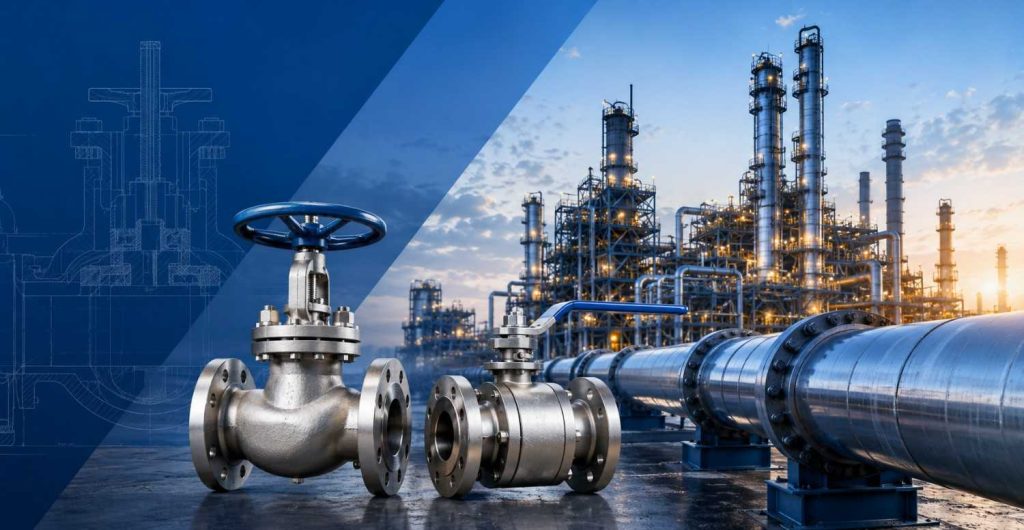
Globe valve vs ball valve—what is the key difference?
A globe valve is designed for throttling and flow regulation. It controls flow using a disc that moves up and down against a seat ring, allowing precise adjustment of flow rate at any intermediate position. It has a higher pressure drop but excellent controllability.
A ball valve is designed for on/off isolation. It controls flow using a hollow rotating ball with a bore through the centre. A quarter turn (90°) fully opens or fully closes the valve. It has a very low pressure drop when fully open but is not suitable for throttling.
In short:
- Use a globe valve when you need to regulate or control flow.
- Use a ball valve when you need to quickly open or shut off flow.
How a globe valve works
A globe valve gets its name from the spherical shape of its body. Inside, a movable plug or disc sits above a fixed seat ring. When the handwheel or actuator is turned, the stem moves the disc vertically — up to allow flow, down to restrict or stop it.
Because the disc can be held at any position between fully open and fully closed, the flow rate through a globe valve can be precisely controlled. This makes globe valves ideal for applications where fine flow adjustment is required throughout the operating cycle.
Key parts of a globe valve:
- Body (cast steel, forged steel, or stainless steel)
- Bonnet
- Disc / plug (the flow control element)
- Seat ring
- Stem (OS&Y — outside screw and yoke)
- Handwheel or actuator
Globe valves are manufactured to BS 1873, API 623, and ASME B16.34 standards. At Flowjet’s Ahmedabad manufacturing facility, globe valves are available from ½” to 24″ in Class 150 to Class 2500.
How a ball valve works
A ball valve uses a hollow ball with a bore (hole) through its centre as the flow control element. The ball rotates on two seats — typically PTFE or metal — inside the valve body.
When the bore aligns with the pipeline, the valve is fully open. When the ball is rotated 90°, the bore is perpendicular to the pipe, and flow is completely blocked. Because there are no intermediate throttling positions, a ball valve is a pure on/off device.
Key parts of a ball valve:
- Body (cast steel, forged steel, or stainless steel)
- Ball (solid or hollow, chrome plated or SS)
- Seats (soft PTFE, reinforced PTFE, or metal-to-metal)
- Stem
- Handle or actuator
Ball valves are manufactured to API 6D, BS 5351, and ASME B16.34 standards. Flowjet manufactures full-bore and reduced-bore ball valves from ½” to 24″ for oil & gas, petrochemical, and utility services.
Globe valve vs ball valve
| Feature | Globe Valve | Ball Valve |
| Primary function | Throttling & flow regulation | On/off isolation |
| Flow control | Excellent — infinite positions | Poor — only fully open or fully closed |
| Pressure drop | High (higher resistance to flow) | Very low (near-zero when fully open) |
| Operation | Multi-turn (handwheel / actuator) | Quarter-turn (90° open to close) |
| Speed of operation | Slow | Very fast |
| Sealing | Metal-to-metal or soft seat | Soft seat (PTFE) or metal-to-metal |
| Seat leakage class | Class IV or VI | Class V or VI |
| Maintenance | Higher — packing and seat wear | Lower — simple design |
| Body shape | Globular / spherical | Cylindrical |
| Size range | ½” to 24″ (typical) | ¼” to 60″+ |
| Pressure class | Up to Class 2500 | Up to Class 2500 |
| Best for | Steam, chemicals, cooling water control | Gas lines, oil lines, isolation service |
| IBR approval | Available | Available |
| Suitable for frequent operation | Yes | Yes |
| Suitable for slurry / dirty fluids | Limited | Limited |
Pressure drop — the most important difference
One of the biggest technical differences between a globe valve and a ball valve is pressure drop across the valve.
Globe valve pressure drop: Because fluid must change direction as it flows through a globe valve body (the flow path is S-shaped), there is significant resistance to flow even when the valve is fully open. This results in a higher pressure drop compared to most other valve types.
The pressure drop across a fully open globe valve is typically 3 to 10 times higher than a fully open ball valve of the same size, depending on the design and flow conditions.
This is acceptable — and sometimes even desirable — in throttling applications where the valve is intentionally restricting flow. But it makes globe valves inefficient for use as simple isolation valves where you want full, unrestricted flow when open.
Ball valve pressure drop: A full-bore ball valve (where the ball bore matches the pipe diameter) has an extremely low pressure drop when fully open — nearly zero resistance to flow. This is why ball valves are the standard choice for isolation and shut-off service on gas lines, oil pipelines, and water systems where pressure loss must be minimised.
Summary:
- If pressure drop matters and you need full, unobstructed flow → use a ball valve.
- If you need to regulate flow and pressure drop is a designed part of the system → use a globe valve.
Throttling — why globe valves are better
Throttling means partially restricting flow to achieve a desired flow rate, pressure, or temperature. Globe valves are purpose-built for this.
When a globe valve is at 25%, 50%, or 75% open, the disc maintains a stable, predictable flow path. The relationship between stem position and flow rate is relatively linear and controllable. This makes globe valves the valve of choice for:
- Steam flow control in boilers and heat exchangers
- Cooling water control in process plants
- Chemical dosing lines
- Feedwater control in power plants
- Fuel oil throttling
Ball valves, by contrast, are poorly suited to throttling. When a ball valve is held at a partially open position (say 30–40% open), the flow velocity is high and turbulent across the edge of the ball and seat. This causes:
- Seat erosion (especially for soft PTFE seats)
- Vibration and noise
- Unpredictable, non-linear flow characteristics
- Premature valve failure
Operating a ball valve in a throttling position is a common maintenance mistake seen across Indian plants — and leads to seat damage and leakage within months.
Rule of thumb: Never use a ball valve for continuous throttling service.
Which valve to use — application-by-application guide
Steam service
Choose: Globe valve Globe valves are the standard choice for steam lines — especially where flow control, pressure regulation, or temperature control is required. They are manufactured to IBR (Indian Boiler Regulations) standards and are approved by all major Indian boiler inspection authorities. Flowjet’s IBR-approved globe valves are widely used in steam service across Ahmedabad, Surat, Vadodara, and across Indian industry.
Oil & gas pipelines
Choose: Ball valve (for isolation) + Globe valve (for throttling/control) Most oil and gas pipelines use ball valves for mainline isolation because of their low pressure drop, fast operation, and pig-passable full bore design. However, globe valves are used at control stations, wellhead chokes, and flow regulation points where precise control is needed.
Chemical & petrochemical plants
Choose: Globe valve (for dosing and control), Ball valve (for isolation) In chemical plants, globe valves handle chemical dosing lines, reflux control, and heat exchanger service. Ball valves are used for block and bleed, process isolation, and emergency shut-off. Both types are used extensively in Ahmedabad’s GIDC chemical corridor.
Cooling water systems
Choose: Globe valve Cooling water lines require constant flow adjustment to maintain temperature targets. Globe valves provide the throttling accuracy needed. Ball valves are used only at the system boundaries for isolation.
Pharmaceutical & food processing
Choose: Ball valve (for sanitary isolation) + Globe valve (for flow control) Sanitary ball valves (with full bore, crevice-free design) are preferred for CIP-compatible isolation in pharma and food lines. Globe valves are used where precise dosing or flow regulation is required.
Fire-fighting systems
Choose: Ball valve Fire-fighting systems require fast, reliable isolation with minimal pressure drop. Ball valves with quarter-turn operation are standard. Globe valves are too slow and have too high a pressure drop for emergency shut-off service.
Boiler feed water
Choose: Globe valve (IBR approved) Globe valves are mandatory for many boiler feed water applications under IBR regulations. They provide the controlled, precise flow required for boiler drum level and feedwater control.
Globe valve vs ball valve — when NOT to use each
Do not use a globe valve when:
- You need fast shut-off (ball valve operates in 90°; globe valve requires multiple turns)
- You need full unrestricted flow with minimal pressure drop (gas transmission, water mains)
- The line has pigging requirements (globe valve body is not pig-passable)
- You need a compact, lightweight valve for tight spaces
Do not use a ball valve when:
- You need to throttle or regulate flow (ball valve seats will erode rapidly)
- The application involves high-temperature steam service where precise control is needed
- The flow needs to be incrementally adjusted in operation
- A control signal (4–20 mA) needs to position the valve at specific intermediate points
Cost comparison — globe valve vs ball valve
Cost is often a factor when selecting between the two valve types, especially for large projects in India.
In general, for standard sizes (2″ to 6″) in carbon steel (WCB):
- Globe valves are typically slightly more expensive than ball valves of the same size and pressure rating, due to the more complex body geometry and machining requirements.
- For larger sizes (8″ and above), globe valves in cast steel become more cost-competitive relative to full-bore ball valves of the same pressure class.
- For special materials (SS316, Duplex, Alloy 20), the cost difference narrows significantly as material cost dominates.
However, selecting the wrong valve type to save cost always results in higher lifecycle costs — through early failure, maintenance, leakage, and production downtime. Choose the valve type for the application, then optimise cost within that type.
Flowjet Valves, based in Ahmedabad, manufactures both globe valves and ball valves in-house and offers competitive project pricing for bulk orders, EPC procurement, and stocking requirements across India.
Globe valve vs ball valve — summary table (quick reference)
| Application | Best Valve | Reason |
| Steam flow control | Globe valve | Throttling, IBR approved |
| Gas line isolation | Ball valve | Low pressure drop, fast operation |
| Boiler feed water | Globe valve | IBR, precise control |
| Chemical dosing | Globe valve | Fine flow regulation |
| Fire-fighting isolation | Ball valve | Fast quarter-turn shut-off |
| Cooling water control | Globe valve | Continuous throttling |
| Oil pipeline mainline | Ball valve | Full bore, piggable, low ΔP |
| Pharma sanitary lines | Ball valve | Hygienic design, CIP-compatible |
| Power plant HP steam | Globe valve (pressure seal) | High pressure, IBR, throttling |
| Process block & bleed | Ball valve | Positive shut-off, compact |
Frequently asked questions (FAQ)
Q1: Can a ball valve be used for throttling? No. Ball valves are not designed for throttling service. When held at a partially open position, the high flow velocity across the ball edge causes rapid seat erosion, vibration, and premature failure. For throttling and flow regulation, always use a globe valve.
Q2: Which valve has less pressure drop — globe valve or ball valve? A ball valve has significantly less pressure drop than a globe valve. A full-bore ball valve in the fully open position has near-zero pressure loss. A globe valve has higher resistance due to the S-shaped flow path, making it less suitable for applications where pressure loss must be minimised.
Q3: Which valve is better for steam service? A globe valve is better for steam service. Globe valves offer precise throttling, can be manufactured to IBR (Indian Boiler Regulations) requirements, and are designed for high-temperature, high-pressure steam lines. Ball valves can be used for steam isolation but are not preferred for steam throttling.
Q4: Globe valve vs ball valve — which is more expensive? In standard carbon steel (WCB) for sizes 2″ to 6″, globe valves are slightly more expensive than ball valves of the same pressure class. For larger sizes (8″+) and special alloy materials, the cost difference is smaller. Always choose valve type based on application requirements, not upfront cost alone.
Q5: Which valve is faster to operate? A ball valve is much faster — it opens or closes fully with a single 90° turn of the handle. A globe valve requires multiple turns (typically 5 to 30+, depending on size) to fully open or close. Ball valves are preferred wherever fast shut-off is required, such as emergency isolation.
Q6: Are globe valves and ball valves available with actuators? Yes. Both globe valves and ball valves are available with electric actuators, pneumatic actuators, and gear operators for remote operation and process automation. Flowjet Valves, Ahmedabad, supplies actuated globe and ball valves with full documentation and wiring diagrams.
Q7: Which valve manufacturer in Ahmedabad supplies both globe and ball valves? Flowjet Valves Pvt. Ltd., located at Kathwada GIDC, Ahmedabad, manufactures both globe valves and ball valves in-house. We supply ISO 9001:2015 certified, IBR-approved valves in carbon steel, stainless steel, and alloy materials to clients across Gujarat, India, and the Middle East.
Why choose Flowjet Valves for globe and ball valves in Ahmedabad?
Flowjet Valves Pvt. Ltd. is a trusted industrial valve manufacturer based in Ahmedabad, Gujarat, with over 35 years of experience supplying globe valves, ball valves, gate valves, and check valves to industries across India and the Middle East.
- ISO 9001:2015 certified manufacturing facility at Kathwada GIDC, Ahmedabad
- IBR approved for steam and boiler service valves
- Third-party inspection by DNV, Bureau Veritas, Matrix, and Lloyd’s Register
- 800+ clients in oil & gas, power, pharma, chemicals, and water treatment
- Both globe valves and ball valves manufactured in-house — sizes ½” to 24″, Class 150 to 2500
- Pan-India delivery with fast dispatch for Ahmedabad, Surat, Vadodara, Rajkot, and Gujarat GIDC customers
Contact Flowjet Valves today for technical specifications, product datasheets, and a competitive quote for your next project.
📍 Kathwada GIDC, Ahmedabad, Gujarat 📞 99786 08334 🌐 www.flowjetvalve.com