
“High performance butterfly valve” is a phrase that gets used a lot. It appears on product pages, in catalogues, and in sales pitches. But if you ask most salespeople what it actually means — technically, specifically, in terms of how the valve is built differently from a standard one — the answer gets vague fast.
That’s a problem. Because if you’re an engineer specifying valves for a demanding process application, or a procurement manager trying to understand why one butterfly valve costs three times another, “high performance” as a descriptor tells you almost nothing useful.
This piece is a real explanation. What high-performance butterfly valves actually are. How they differ from standard concentric designs. When they’re the right choice and when they’re not. And what to look for in a high performance butterfly valve manufacturer before you trust them with a critical application.
Flowjet Valve manufactures high-performance butterfly valves in Ahmedabad, Gujarat. We’ll tell you what we build and why — and we’ll be honest about where the design limits are.
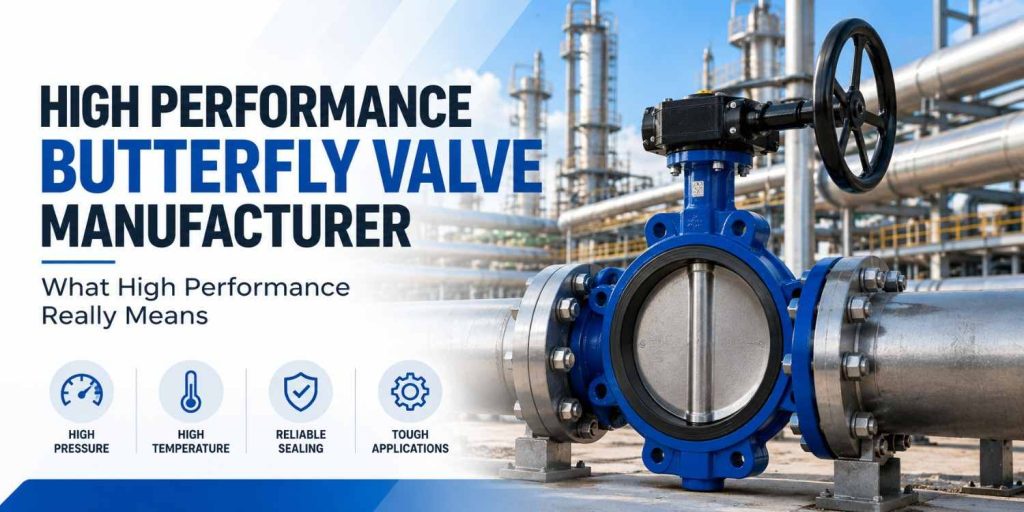
Standard Concentric vs High Performance — The Core Difference
To understand what makes a high performance butterfly valve different, you first need to understand the limitation of the standard concentric design.
In a standard concentric butterfly valve, the disc rotates on a stem that passes through the exact centre of the disc and pipe bore. When the disc closes, it presses against the seat — an elastomeric liner — by rotating into contact with it.
This creates a problem. As the disc rotates toward the closed position, it continuously rubs against the seat in an arc of contact — not just at the final closed position. The seat and disc are in contact throughout the last few degrees of the closing stroke. This continuous rubbing accelerates seat wear. It also means the valve generates friction throughout its operating cycle, which increases actuator torque requirements and shortens service life.
In standard service conditions — water, mild chemicals, moderate pressure — this limitation is manageable. The valve works. Seats are replaced periodically. Life is fine.
But in high-pressure service, high-temperature service, or applications with aggressive media, this limitation becomes a real engineering problem. The seat degrades faster. The operating torque climbs. The valve becomes unreliable at the exact conditions where reliability matters most.
High performance butterfly valve designs — specifically double eccentric and triple offset configurations — solve this problem through geometry. They eliminate the continuous rubbing by changing how the disc relates to the seat during the closing stroke.
Double Eccentric (Double Offset) Butterfly Valve
In a double eccentric butterfly valve, two offsets are introduced into the stem geometry.
The first offset moves the stem slightly behind the disc face — not through the centre of the disc, but offset toward the upstream side. The second offset moves the stem laterally away from the pipe centreline.
These two offsets together mean that when the disc rotates, it follows a cam-like path rather than a pure rotation around the pipe centre. The disc swings away from the seat as it opens, and the last few degrees of closing stroke are the only time the disc contacts the seat.
The result: far less seat wear. Lower operating torque. Longer service life. And the ability to achieve reliable shutoff at higher pressures and temperatures than a standard concentric valve can handle.
Double eccentric designs can accommodate elastomeric seats for moderate-temperature service and metal seats for high-temperature applications. They’re suitable for ASME Class 150 and Class 300 service — and some designs push into Class 600 territory.
Flowjet Valve manufactures double eccentric butterfly valves in Ahmedabad in carbon steel, stainless steel, and cast iron bodies, with EPDM, PTFE, and metal seat options across DN 50 to DN 600.
Triple Offset (Triple Eccentric) Butterfly Valve
The triple offset butterfly valve takes the eccentric geometry one step further.
In addition to the two offsets described above, the third offset changes the geometry of the seating surface itself. In a standard or double eccentric butterfly valve, the disc face and seat are essentially conical or flat — they make contact in a full circular arc. In a triple offset design, the seating surface is machined at a precise cone angle that’s different in orientation from the disc face.
The effect is that the disc and seat don’t make contact at all during most of the stroke. Contact only occurs in the final moment of full closure — when the tapered seating surfaces meet and create a tight metal-to-metal seal.
This means zero disc-to-seat rubbing during operation. No elastomeric seat needed — the seal is metal-to-metal. And the sealing mechanism actually improves under higher differential pressure, because the pressure pushes the tapered disc more firmly into the tapered seat.
Triple offset butterfly valves are genuinely capable of high-pressure, high-temperature service. They handle differential pressures that would destroy a standard concentric valve in days. They achieve bubble-tight metal-to-metal shutoff to leakage class VI. They work reliably in steam, hydrocarbons, and aggressive chemical environments where elastomeric seats can’t survive.
They’re also more expensive and more complex to manufacture. A triple offset design requires extremely precise machining of both the disc taper and the seat ring taper. Any deviation from the specified geometry and the valve doesn’t seal correctly. This is not a forgiving design — it rewards precision manufacturing and punishes shortcuts.
This is why choosing the right high performance butterfly valve manufacturer matters enormously. A manufacturer who claims to produce triple offset designs but can’t demonstrate the machining precision behind the geometry is producing something that looks like a triple offset valve but doesn’t perform like one.
What “High Performance” Actually Means — A Checklist
When a supplier says “high performance butterfly valve,” here’s what you should be verifying:
Design geometry: Is it double eccentric or triple offset? Or is it still a standard concentric design with a better seat material? Get the technical drawing. Ask to see the stem offset dimensions.
Pressure-temperature rating: A genuine high performance butterfly valve should be rated for higher pressure and temperature than a standard design. What is the specific pressure class and temperature limit? Not “suitable for high pressure” — the actual ASME class and maximum temperature.
Seating mechanism: Does the valve have an elastomeric seat or a metal seat? Metal-to-metal seating in a properly manufactured triple offset design delivers leakage class VI. An elastomeric seat, regardless of the geometry, has temperature limits.
Leakage class: Ask for the test report to API 598. What leakage class does it achieve? A real high performance butterfly valve should be able to demonstrate its shutoff performance against a recognised test standard.
Materials: High performance service conditions usually mean more demanding material requirements. What’s the body material? What’s the disc material? What’s the stem material? A carbon steel body with a cast iron disc is not a high performance product, regardless of what the brochure says.
Manufacturer’s machining capability: Triple offset geometry is only as good as the machining that creates it. Ask about the manufacturer’s CNC capability, tolerances, and quality inspection process. Can you visit the facility?
Flowjet Valve’s high performance butterfly valve facility at GIDC Kathwada, Ahmedabad is open to plant engineers and procurement teams for factory visits. The machining floor, assembly area, and testing lab are what you evaluate — not just the certificate on the wall.
When to Specify a High Performance Butterfly Valve
Not every application needs a high performance design. Standard concentric butterfly valves are genuinely the right choice for a large proportion of industrial applications — cooling water, HVAC, fire protection, general utilities.
Specify a high performance butterfly valve when:
Pressure exceeds standard concentric limits. Standard concentric designs are typically suitable for PN 10 to PN 16 in soft-seated configurations. For PN 25 and above, or ASME Class 300 and above, double eccentric or triple offset designs handle the differential pressure without seat damage.
Temperature exceeds elastomeric seat limits. EPDM degrades above approximately 120°C in continuous service. PTFE has limits around 180–200°C. For steam service, hot oil, or process fluids above these temperatures, metal-seated high performance designs are the engineering solution — not a workaround.
The valve cycles frequently. Every time a standard concentric butterfly valve opens and closes, the disc rubs the seat. In high-cycle applications — automated process control, frequent isolation — this accelerates seat wear significantly. A double eccentric design with its near-frictionless opening stroke extends seat life dramatically in high-cycle service.
Tight shutoff is a genuine requirement. If your process requires bubble-tight shutoff — not just “reasonably sealed” — and you’re in a demanding service condition, a triple offset metal-seated design achieves leakage class VI consistently where a standard concentric design cannot.
The application involves aggressive chemicals. EPDM and PTFE seats have chemical compatibility limits. Metal-to-metal seating in a triple offset design eliminates the seat material compatibility question in most aggressive chemical environments.
High Performance Butterfly Valve Applications
Where are these valves actually being used in Gujarat and across India?
Chemical and petrochemical plants: Gujarat’s chemical corridor — Vatva, Naroda, Ankleshwar, Vapi, Dahej — uses high performance butterfly valves on high-pressure isolation, chemical feed lines with elevated temperature, and applications where standard concentric valves have failed repeatedly in service.
Power plants and co-generation: Steam isolation, high-pressure turbine bypass, and boiler feed system service. These applications genuinely require the pressure and temperature capability that only high performance designs deliver.
Refineries and oil and gas facilities: Pipeline isolation, hot oil service, and high-pressure hydrocarbon lines. Metal-seated triple offset designs are the standard specification in serious oil and gas applications.
Pharmaceutical plants: High-temperature sterilisation service in pharmaceutical manufacturing requires valves that can handle repeated steam cycles without seat degradation. Triple offset designs in stainless steel are increasingly specified for autoclave and sterilisation service.
District heating and cooling: High-pressure hot water distribution systems where standard concentric valves fail at the pressure-temperature combination of the service condition.
Why Local Matters — High Performance Butterfly Valve Manufacturer Near Me
When plant engineers and procurement managers in Ahmedabad, Vadodara, Surat, Rajkot, Gandhinagar, or anywhere across Gujarat search for a “high performance butterfly valve manufacturer near me” — the proximity question isn’t just about convenience.
High performance butterfly valves, particularly triple offset designs, sometimes require on-site discussion of application conditions before the right configuration can be confirmed. The conversation about cone angle, seat material, pressure class, and end connection type is easier face-to-face than through email chains.
When something needs to be verified — a dimensional check against existing piping, a material compatibility question about a specific chemical, a review of the datasheet before finalising an order — working with a high performance butterfly valve manufacturer who is physically reachable makes all of this faster.
Flowjet Valve at GIDC Kathwada, Ahmedabad is accessible from:
- Vatva industrial area: 25 minutes
- Naroda GIDC: 15 minutes
- Gandhinagar industrial estates: 30 minutes
- Vadodara: approximately 1.5 hours
- Surat: approximately 3 hours
- Rajkot: approximately 3.5 hours
For Gujarat-based buyers, a factory visit to see the machining and testing process is the most efficient way to qualify a high performance butterfly valve manufacturer. It takes a few hours. It tells you more than months of email exchange.
Flowjet Valve — High Performance Butterfly Valve Manufacturer, Ahmedabad
Flowjet Valve manufactures double eccentric and triple offset butterfly valves at our GIDC Kathwada, Ahmedabad facility for process industries across Gujarat and India.
Our high performance butterfly valve range:
Double Eccentric Butterfly Valves Size range: DN 50 to DN 600 Pressure class: ASME Class 150 to Class 300 Body materials: Cast iron, ductile iron, carbon steel, stainless steel SS 316 Seat options: EPDM, PTFE, NBR, metal seat Operation: Manual lever, gear, pneumatic actuated, electric actuated Standards: API 609, API 598, ASME B16.34
Triple Offset Butterfly Valves Size range: DN 50 to DN 600 Pressure class: ASME Class 150 to Class 600 Body materials: Carbon steel WCB, stainless steel CF8M, alloy steel Seat: Metal-to-metal (Stellite hard-faced seat ring) Leakage class: Class VI to API 598 Temperature range: -29°C to 600°C depending on material Standards: API 609, API 598, ASME B16.34 Documentation: MTC, hydrostatic test report, seat-leak test to leakage class VI
Frequently Asked Questions
What is a high performance butterfly valve? A high performance butterfly valve is a double eccentric or triple offset butterfly valve designed for higher pressure, higher temperature, and more demanding service than a standard concentric butterfly valve. The eccentric geometry reduces disc-to-seat contact during the operating stroke, extending seat life and reducing operating torque. Triple offset designs use metal-to-metal seating for the highest pressure and temperature capability.
What is the difference between double eccentric and triple offset butterfly valves? A double eccentric butterfly valve has two stem offsets that reduce seat wear during the operating stroke. It typically uses an elastomeric or soft seat. A triple offset butterfly valve adds a third geometric offset — a precisely machined cone angle on the seating surfaces — that creates a metal-to-metal seal at full closure. Triple offset designs handle higher pressures and temperatures and achieve leakage class VI shutoff.
Where can I find a high performance butterfly valve manufacturer near me in Gujarat? Flowjet Valve manufactures high performance butterfly valves at GIDC Kathwada, Ahmedabad — serving buyers across Gujarat, including Vadodara, Surat, Rajkot, Gandhinagar, Ankleshwar, and Vapi. Factory visits are welcome for buyer qualification.
What pressure class can a high performance butterfly valve handle? Double eccentric designs typically handle ASME Class 150 to Class 300. Triple offset designs can handle Class 150 to Class 600, with some configurations extending to Class 900. The specific pressure-temperature rating depends on the body material and seat type.
Can high performance butterfly valves replace globe valves in throttling service? In some applications, yes. Triple offset butterfly valves with modulating actuators can provide throttling service with adequate control characteristics in many applications. However, globe valves still provide better inherent flow characteristics for precise throttling across a wide range of opening positions. The choice depends on the specific control requirement and service condition.