
A water treatment plant engineer in Surat once told me something that stuck. He said, “We spent three months getting the pump selection right and three minutes picking the butterfly valves. Guess which one gave us problems?”
It’s a common story across WTP projects in Gujarat. Engineers pour energy into the big equipment — clarifiers, aerators, filter beds — and treat valve selection as a commodity decision. Then the seat fails at month four. Or the valve dimensions don’t match the flange pattern. Or a valve that was specified for clean water gets put on a chemical dosing header and the liner dissolves.
Butterfly valves are the most widely used isolation and control valves in water treatment plants. They’re compact, they handle large diameters economically, and they operate with less torque than gate valves of equivalent size. But “butterfly valve for water treatment plant” isn’t one specification — it’s a family of requirements that changes depending on where in the treatment process the valve sits.
This guide is written to help WTP engineers, procurement managers, and project consultants get that specification right from the start.
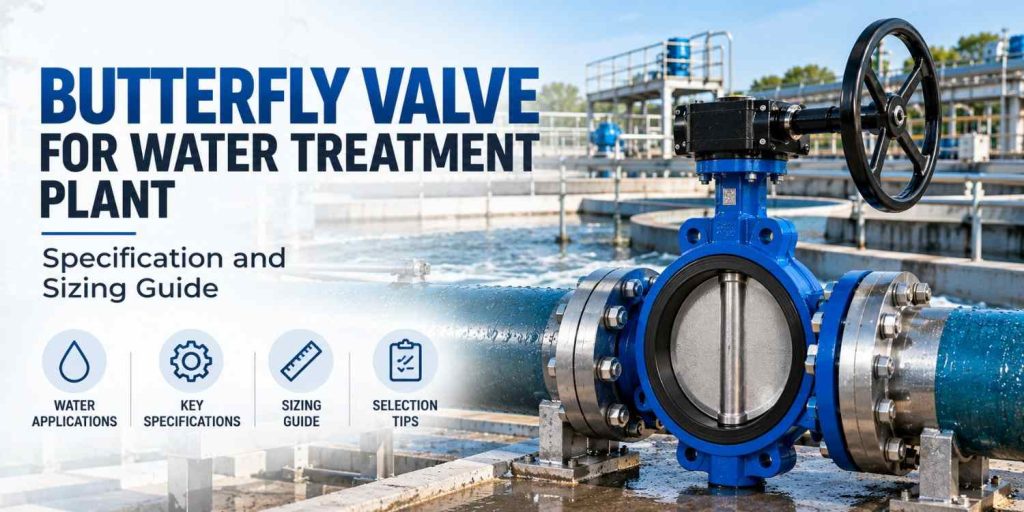
Why Butterfly Valves Dominate Water Treatment Plant Design
Walk through any municipal water treatment plant, industrial WTP, or sewage treatment facility in Gujarat and you’ll see butterfly valves on almost every header, manifold, and distribution line. The reasons are practical.
For large diameter service — DN200 and above — butterfly valves are significantly more economical than gate valves, both in unit cost and installation weight. A gate valve at DN400 requires substantial structural support; a butterfly valve at the same size is a fraction of the weight and installs in far less space.
They open and close quickly, which matters in automated WTP systems where process control requires fast isolation. With a pneumatic or electric actuator, a butterfly valve can go from fully open to fully closed in a few seconds — a response speed that gate valves and globe valves can’t match at large diameters.
They’re also throttlable in many applications — not with the precision of a globe valve, but adequate for balancing flow across distribution headers and filter inlet manifolds.
Flowjet Valve, based in GIDC Kathwada, Ahmedabad, has supplied butterfly valves for water treatment plants across Gujarat, Rajasthan, and Maharashtra — municipal projects, industrial WTPs, and effluent treatment systems. The specification questions that come from WTP projects are consistently different from chemical plant requirements, and that experience shapes how we approach WTP enquiries.
Mapping the Process — Where Each Valve Type Belongs
A water treatment plant isn’t a single environment. Raw water intake is different from treated water distribution. Chemical dosing headers are different from sludge lines. Getting the valve specification right starts with understanding which part of the process you’re specifying for.
Raw Water Intake and Pre-Treatment
Valves on raw water intake headers handle water with suspended solids, silt, and biological matter. The primary concern here is body material and seat durability. Cast iron body with EPDM seat is the standard specification for most raw water intake butterfly valves in this service — cost-effective, adequate chemical resistance for clean water environments, and long seat life when the water is not chemically aggressive.
For larger diameter intake lines — DN600 and above — double flanged butterfly valves are often preferred over wafer type, as the flanged connection provides better mechanical stability on large headers that see vibration from nearby pumps.
Coagulation, Flocculation, and Clarification
Butterfly valves in coagulation and flocculation stages control flow into and out of mixing tanks and clarifier basins. These valves see clean water with low chemical loading, so standard ductile iron body with EPDM seats performs well here.
The main sizing consideration in this zone is that flow control is often as important as isolation — engineers sometimes specify butterfly valves with positioner-equipped actuators on clarifier inlet lines to maintain consistent flow rates through the treatment stages.
Filtration Systems — Inlet, Outlet, and Backwash Lines
Filter inlet and outlet valves on rapid sand filters or pressure filters are among the highest-cycle valves in a water treatment plant. A backwash cycle might happen once every 24 to 48 hours, but each cycle involves multiple open-close operations on the same valve. Over a year, that adds up to thousands of cycles.
For high-cycle filter service, the seat material choice becomes critical. EPDM is the standard, but the quality of the EPDM compound — its compression set resistance, its durability over repeated cycling — varies significantly between butterfly valve manufacturers. Flowjet Valve’s EPDM-seated butterfly valves for WTP service are specified with injection-moulded EPDM seats, not wrapped seats, which provides better dimensional stability and longer service life under repeated cycling.
Backwash headers also see higher pressure differentials than normal service lines — typically 8 to 10 bar during a backwash cycle. Make sure the butterfly valve pressure rating accounts for this operating condition, not just the normal operating pressure.
Chemical Dosing Lines — Chlorination, Coagulation Chemicals, pH Adjustment
This is where most WTP valve failures happen, and they happen because people apply water service specifications to chemical service lines.
Chlorine dosing, alum dosing, lime slurry, and pH correction chemicals all require specific seat materials. Chlorinated water at typical dosing concentrations — 1 to 5 mg/L — is handled adequately by EPDM. Higher chlorine concentrations in hypochlorite dosing lines need more careful consideration; EPDM handles dilute hypochlorite, but higher concentrations are better served by PTFE or Viton seats.
Alum and ferric sulphate dosing lines — common coagulants in Indian WTPs — require careful body material selection. Standard cast iron corrodes relatively quickly in alum solutions. Ductile iron is marginally better but still not ideal. For dosing line valves handling coagulants, stainless steel bodies — SS 304 or SS 316 — are the right specification. The premium over cast iron is real, but it’s small compared to the cost of replacing corroded valves every eighteen months.
Lime slurry lines are abrasive as well as alkaline. Butterfly valves on lime dosing headers need to account for abrasion on the disc and seat. Rubber-lined designs with thick elastomer seats handle lime slurry better than standard configurations.
Treated Water Distribution and Storage
On the clean water side — clearwell headers, distribution manifolds, and storage tank connections — the specification simplifies. Clean treated water, low chemical loading, standard operating pressures. Cast iron or ductile iron body with EPDM seat, wafer or lug type depending on end connection requirements, and standard pressure ratings of PN10 or PN16 are appropriate for most municipal distribution applications.
Sizing Butterfly Valves for Water Treatment Plant Applications
Valve sizing is where many projects go wrong. The common mistake is simply matching the valve size to the pipe size — a DN200 pipe gets a DN200 butterfly valve. For isolation valves, this is usually fine. For throttling or flow control applications, it’s not always correct.
For isolation service: Size the valve to match the pipe diameter. Ensure the pressure rating covers the maximum system pressure, including pump start-up pressure surges.
For throttling service: A butterfly valve used for flow control typically operates in the 30° to 70° open range. At low openings — below 20° — the valve is in a high-velocity, turbulent flow condition that causes accelerated seat and disc wear. At openings above 70°, control resolution is poor. If a butterfly valve will be used for throttling, confirm with the manufacturer what the recommended operating range is for that specific design, and consider whether the process requires tighter control than a butterfly valve can provide.
Actuator torque sizing: The torque required to operate a butterfly valve increases significantly at the start-of-open and end-of-close positions. An undersized actuator that can move the valve through mid-stroke may not generate enough torque to fully open or fully close against system pressure. Flowjet Valve provides actuator sizing calculations as part of the technical support offered to WTP project specifiers.
Flow coefficient (Cv/Kv) check: For any valve used in flow control service, verify the flow coefficient at the intended operating position matches the required flow rate. A valve that’s oversized for a control application will spend most of its life at very low openings — which accelerates wear and reduces control precision.
Specification Checklist — What to Define Before Ordering
Before sending an enquiry to a butterfly valve manufacturer for a WTP project, having these parameters defined saves time and ensures accurate proposals:
- Line size and pressure rating (DN and PN, or NPS and ANSI Class)
- Fluid service — raw water, treated water, chemical dosing, sludge, effluent
- Operating pressure and temperature — normal and maximum
- End connection type — wafer, lug, or double flanged
- Actuation — manual handwheel, gear-operated, pneumatic, or electric
- Seat material — EPDM for water service; PTFE or Viton for chemical service
- Body material — cast iron for standard water service; SS 304/316 for chemical lines
- Testing requirements — hydrostatic body test, seat leak test to API 598
- Any third-party inspection — IBR, CCOE, or client TPI requirements
- Quantity and delivery requirements — stocked standard items vs. fabricated specials
Flowjet Valve handles WTP project enquiries with a structured technical review — we ask for these parameters upfront because getting them right the first time is faster for everyone than correcting a misspecified order after delivery.
Why Gujarat WTP Projects Choose Flowjet Valve
Water treatment projects across Ahmedabad, Gandhinagar, Surat, Rajkot, and Vadodara have increasingly included Flowjet Valve in their approved vendor lists for butterfly valve supply. The reasons cited are consistent.
Local availability matters in WTP projects. A project site near Ahmedabad that needs a replacement valve during commissioning doesn’t want to wait a week for freight from another state. Flowjet Valve’s GIDC Kathwada facility stocks finished butterfly valves in standard sizes across DN50 to DN600 — most standard items ship the same day or next day.
Documentation quality holds up during project audits. Municipal and industrial WTP projects handled by EPC contractors require material test certificates, hydrostatic test records, and dimensional inspection reports as part of the project handover package. Flowjet Valve provides these as standard, not as an additional request.
The technical support is genuine. When a WTP project specifier calls with a specific process question — whether EPDM is suitable for their particular chlorine concentration, or what actuator torque is needed for a DN400 valve at 6 bar — the response is a technical answer, not a sales pitch.
Summary
A butterfly valve for a water treatment plant isn’t a single specification. Raw water intake, chemical dosing, filtration backwash, and treated water distribution all have different requirements — different body materials, seat materials, pressure ratings, and actuation needs.
Getting those specifications right at the start prevents the problems that cost plants unplanned downtime and premature valve replacement. And sourcing from a butterfly valve manufacturer near you in Ahmedabad who understands WTP process requirements makes the entire procurement and support experience significantly simpler.
Flowjet Valve supplies butterfly valves for water treatment plants across Gujarat and across India. For project enquiries, technical consultations, or sample documentation requests, reach us directly.