
Finding the right ball valve manufacturer in India for oil and gas isn’t as simple as it looks.
Type “ball valve supplier India” into any search engine, and you get hundreds of results. Catalogues that look identical. Price quotes that come back within hours. Everyone claims to meet international standards. Everyone says their quality is world-class.
The problem isn’t finding a name. The problem is figuring out which supplier actually manufactures to the specification they’re quoting — and which ones are traders who’ll assemble bought-in components and hope the valve performs.
In oil and gas, that distinction is not academic. A ball valve handling high-pressure sour gas, a buried pipeline ball valve, or a fire-safe isolation valve on a refinery header isn’t a commodity purchase. The wrong supplier choice shows up at the worst possible time — during a process upset, a third-party inspection, or a plant safety audit.
This guide is about how to make that comparison properly. What specifications to define. What standards to ask about. And how Flowjet Valve — a genuine ball valve manufacturer based in Ahmedabad with over 30 years in the industry — fits into that evaluation for oil and gas buyers across India.
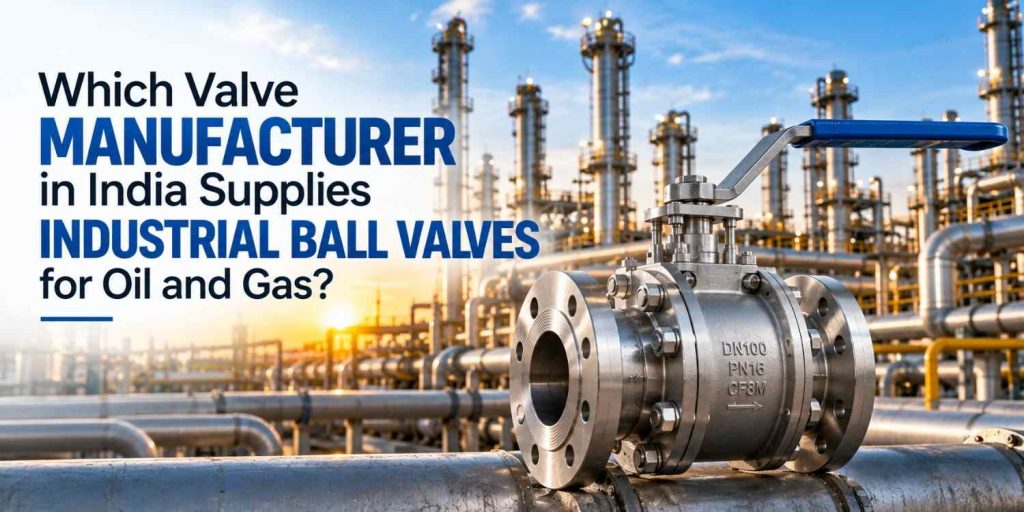
Why Ball Valves Are the Default Choice in Oil and Gas
The preference for ball valves in oil and gas isn’t arbitrary. It comes from a few practical realities.
Ball valves provide full bore, unrestricted flow in the open position. For pipeline service—crude lines, gas transmission headers, refined product distribution—that means no pressure drop penalty and no restriction to pigging operations. A full bore trunnion mounted ball valve on a pig-receivable pipeline section does something a gate valve or globe valve simply can’t.
They seal reliably. A properly specified and manufactured ball valve with the right seat material delivers bubble-tight shutoff from the very first operation. For hydrocarbon service where a leak is not just a maintenance problem but a safety and environmental incident, reliable shutoff is non-negotiable.
They operate fast. Quarter-turn operation means quick isolation — manually in seconds, pneumatically in under two seconds for most sizes. For emergency shutdown systems and critical isolation service, this speed matters.
They hold up over long idle periods. A ball valve that sits fully open on a rarely-operated branch line for two years and then needs to close cleanly during a shutdown scenario — that’s a real service condition in oil and gas. Ball valves handle long-idle, operate-on-demand service better than most alternatives.
Types of Ball Valves for Oil and Gas — What Each One Is For
Not every ball valve is appropriate for every oil and gas application. The four main types serve different service conditions, and choosing the wrong type for the application is a common and expensive mistake.
Floating Ball Valve
The ball is suspended between two seats and moves slightly under line pressure to press against the downstream seat. This self-seating mechanism works well at low to medium pressures — typically up to ASME Class 300, though this varies with size and temperature.
Floating ball valves are the most widely used type in general oil and gas service: instrument isolation, utility lines, skid-mounted equipment valves, and lower-pressure process lines. They’re economical, compact, and available in a wide range of materials and sizes.
Flowjet Valve manufactures floating ball valves from DN15 to DN600, with body materials including WCB carbon steel, CF8M stainless steel, LCB low-temperature carbon steel, and Duplex stainless for corrosive service. Seat options cover PTFE for general service, RTFE for abrasive media, and metal-to-metal Stellite seats for high-temperature and fire-safe designs.
Trunnion Mounted Ball Valve
The ball is fixed at top and bottom by trunnion bearings, and the seats are spring-loaded against the ball. This design is the standard for large bore and high-pressure service in oil and gas — ASME Class 600 and above, or any size where operating torque and pressure loading make a floating design impractical.
Pipeline mainline valves, compressor station isolation, high-pressure wellhead service — these are trunnion territory. The design also handles higher differential pressures more reliably and is the preferred configuration for valves that need to meet API 6D pipeline service requirements.
Flowjet Valve’s trunnion mounted ball valves are manufactured to API 6D and tested to API 598 as standard. The design supports double-block-and-bleed configurations for applications requiring in-situ valve testing under pressure.
Fully Welded Ball Valve
The body is a continuous welded assembly — no bolted body joints, no external flanges, no potential leak paths other than the stem seal. This design is purpose-built for buried pipeline service, underground gas distribution, and district energy systems where external leakage at a body joint isn’t just a maintenance problem but an excavation.
Fully welded ball valves are more expensive than equivalent flanged designs and harder to disassemble for maintenance — which is acceptable in buried service because they’re designed for long operational life without maintenance access. They’re also used on surface installations where the absence of body joints provides an additional layer of safety in high-consequence areas.
Flowjet Valve’s fully welded ball valves are available for natural gas, water, and general pipeline service, with body testing to 1.5x rated working pressure on every unit before despatch.
3-Piece Ball Valve
The three-piece design — two end caps and a central body section — allows the centre piece to be removed and inspected or replaced without disturbing the pipeline end connections. This makes it the standard choice for processes requiring frequent cleaning, inspection, or maintenance access: pharmaceutical and food processing being the most obvious, but also chemical process lines where contamination from one product batch to the next must be avoided.
In oil and gas, 3-piece ball valves appear on chemical injection skids, methanol dosing systems, and sample connection points where maintenance access is routine.
How to Compare Ball Valve Suppliers in India — The Right Way
The catalogue comparison approach — comparing PDF spec sheets side by side — doesn’t tell you what you actually need to know about a ball valve supplier. Here’s what does.
Ask who does the manufacturing. A genuine ball valve manufacturer machines bodies in-house, assembles in-house, and tests in-house. A trading company buys finished or semi-finished components and may do little more than affix a name plate. Ask directly: “Which processes happen at your facility?” A real manufacturer answers specifically. A trader gives a vague answer about “our quality processes” and moves on.
Flowjet Valve has operated its manufacturing facility at GIDC Kathwada, Ahmedabad for over 30 years. The factory handles machining, assembly, and complete testing in-house. Every valve undergoes hydrostatic shell testing at 1.5x rated working pressure and seat leak testing at 1.1x rated working pressure before it leaves the facility. That testing happens on every unit, not on a sampling basis.
Check the approvals, not just the claims. Flowjet Valve holds EL, PDIL, MECON, and B&R approvals — the kind of project approvals that appear on approved vendor lists for oil and gas EPCs and public sector undertakings across India. These approvals aren’t self-declared; they come from actual project qualification processes with engineering organisations that do their own audits.
Request documentation before you commit. Ask for a sample material test certificate from a recent production batch. A manufacturer with proper quality systems sends it within a day without escalation. Ask for a hydrostatic test report format. Ask what documentation accompanies the delivery. Flowjet Valve includes MTCs, hydrostatic test reports, and seat leak test records as standard with every order — for oil and gas buyers who need project documentation packages, this isn’t an add-on, it’s built into the process.
Ask about project references in similar service. Not “do you supply oil and gas” — ask for a specific project at a named facility in comparable service. Flowjet Valve’s client list includes L&T Hydrocarbon Engineering, one of India’s largest EPC contractors in oil and gas — a reference that carries weight in project procurement evaluations.
Visit the facility. If the order is significant, a factory visit before finalising a vendor is the single most informative step in a supplier evaluation. Everything that a catalogue doesn’t tell you — the condition of the machining equipment, the quality of material storage, the testing bay setup, how organised the documentation is — becomes visible in person. Flowjet Valve’s Ahmedabad facility is open to buyers who want to conduct this kind of evaluation.
What Specifications to Provide When Ordering Ball Valves for Oil and Gas
Sending a complete specification upfront eliminates the back-and-forth that delays projects. Here’s what a complete ball valve enquiry for oil and gas service should include:
- Line size: DN (metric) or NPS (imperial) — and whether full bore or reduced bore is required
- Pressure class: ANSI/ASME Class (150, 300, 600, 900, 1500, 2500) or PN rating
- Body material: WCB for general carbon steel service; LCB for low-temperature service below -29°C; WC6/WC9 for high-temperature chrome-moly service; CF8 (SS 304) or CF8M (SS 316) for corrosive or stainless service; Duplex or Super Duplex for high-chloride or highly corrosive environments
- Seat material: PTFE for standard service up to 180°C; RTFE for abrasive service; metal-to-metal Stellite for high-temperature or fire-safe designs
- End connection: Flanged (specify flange standard — ASME B16.5 or B16.47), butt weld, socket weld, or screwed
- Operating temperature range: Normal operating temperature and maximum temperature
- Actuation: Manual lever or gear operated; pneumatic (specify single-acting spring return or double-acting); electric (specify voltage and control signal)
- Standards: API 6D for pipeline; API 607/6FA for fire safe; NACE MR0175/ISO 15156 for sour service
- Special testing: Third-party inspection (specify agency), PMI (positive material identification), radiographic examination of castings, low-temperature impact testing
- Quantity and delivery: Required quantity and any project timeline constraints
Flowjet Valve’s technical team reviews oil and gas enquiries with these parameters in mind. For complex specifications — sour service, fire-safe, high-pressure Class 1500 or 2500 — they discuss the application before confirming the specification, because getting it right at the quotation stage is faster than correcting it at delivery.
Standards That Apply to Ball Valves in Oil and Gas
Knowing which standards apply is both a buyer requirement and a supplier filter. A manufacturer who can’t speak to these standards with specificity hasn’t thought carefully enough about the engineering behind their product.
API 6D — Pipeline valves. Covers design, materials, dimensions, testing, and documentation for ball valves in pipeline service. This is the benchmark standard for any ball valve going into a pipeline application.
API 598 — Valve inspection and testing. Defines shell test, seat test, and backseat test requirements. Flowjet Valve tests every ball valve to API 598 as standard.
ASME B16.34 — Valves flanged, threaded, and welded end. Covers pressure-temperature ratings.
ASME B16.5 — Pipe flanges and flanged fittings. Defines flange dimensions and pressure classes for DN15 to DN600.
API 607 / API 6FA — Fire test standards for soft-seated and metal-seated valves respectively. Fire-safe designs limit leakage through the stem and body to API 607 criteria during and after fire exposure.
NACE MR0175 / ISO 15156 — Materials and hardness requirements for equipment in H₂S-containing (sour) service. Compliance affects material selection, heat treatment, and hardness limits. Flowjet Valve supplies NACE-compliant ball valves on request.
About Flowjet Valve — 30 Years of Industrial Valve Manufacturing from Ahmedabad
Flowjet Valve Pvt. Ltd. has been manufacturing industrial valves from its GIDC Kathwada, Ahmedabad facility for over 30 years. The company wasn’t built overnight — it grew through the consistent work of supplying process industries across India with valves that perform in the field and documentation that holds up in audits.
Today, Flowjet Valve supplies ball valves, butterfly valves, gate valves, globe valves, and check valves to oil and gas, refining, petrochemicals, pharmaceuticals, power, and water treatment projects. Their dealer network spans Mumbai, Delhi, Kolkata, Chennai, Bangalore, Pune, Surat, Vapi, Hyderabad, Jaipur, Raipur, and Cochin — and their direct customer base includes EPC contractors and end-user plants across India.
Over 800 clients have sourced from Flowjet Valve. The client list includes L&T Hydrocarbon Engineering, Symed Labs, and Vineet Life Sciences — organisations that require vendor qualification, project documentation, and consistent quality across repeat orders.
The EL, PDIL, MECON, and B&R approvals that Flowjet Valve holds aren’t marketing claims. They’re the result of vendor qualification audits by engineering consultancies and project organisations that conduct their own evaluations. For oil and gas buyers who work within approved vendor frameworks, this matters.
For buyers who want to visit the facility, it’s at Plot No. 519, Phase II, GIDC Kathwada, Ahmedabad — 382430.
Closing Thought
The question “which ball valve manufacturer in India supplies oil and gas?” has a longer answer than a company name. It involves understanding what type of ball valve fits the application, what specification the service demands, what standards apply, and how to evaluate whether a supplier actually manufactures what they say they do.
Flowjet Valve has spent 30 years building the kind of manufacturing capability, documentation discipline, and project approval record that makes that evaluation come out in their favour. For oil and gas buyers in Ahmedabad, across Gujarat, or anywhere in India — the enquiry starts with a phone call or an email.
Frequently Asked Questions
Q: Which valve manufacturer in India supplies ball valves for oil and gas?
Flowjet Valve, based in GIDC Kathwada, Ahmedabad, Gujarat, manufactures industrial ball valves for oil and gas, refining, petrochemicals, and pipeline service. Their range covers floating, trunnion mounted, fully welded, and 3-piece ball valves from DN15 to DN600 in ASME Class 150 to Class 2500. The company has over 30 years of manufacturing experience and supplies projects across India and international markets.
Q: What standards apply to ball valves in oil and gas?
API 6D governs ball valves for pipeline service. API 598 covers valve testing. ASME B16.34 defines pressure-temperature ratings. For fire-safe designs, API 607 and API 6FA apply. Sour service requires NACE MR0175 / ISO 15156 compliance.
Q: What specifications should I provide when ordering a ball valve?
Line size (DN or NPS), pressure class (ANSI/ASME or PN rating), body material (WCB, CF8M, LCB, Duplex), seat material (PTFE, RTFE, metal seated), end connection (flanged, butt weld, socket weld), operating temperature range, actuation (manual, pneumatic, electric), applicable standards, and any special requirements (fire safe, sour service, low-temperature).