When you’re looking at two butterfly valve quotations side by side, and one supplier mentions ISO certification while the other doesn’t, it’s easy to treat it as a minor detail. A box-ticking exercise. Something that matters to auditors but not to the plant floor.
That’s a mistake. And it’s the kind of mistake that tends to reveal itself at the worst possible time — during an inspection, during a quality audit, or when a valve that looked perfectly fine on a spec sheet fails in service. There’s no traceable record of how it was made or tested.
ISO certification, when it’s genuine and not just a logo borrowed from a third party, tells you something real about a butterfly valve manufacturer. Not everything — but enough to matter significantly when you’re deciding who to trust with components that will live inside a pressurised pipeline for years.
Here’s what it actually means and why it should be on your evaluation checklist.
What ISO 9001 Actually Covers — In Plain Language
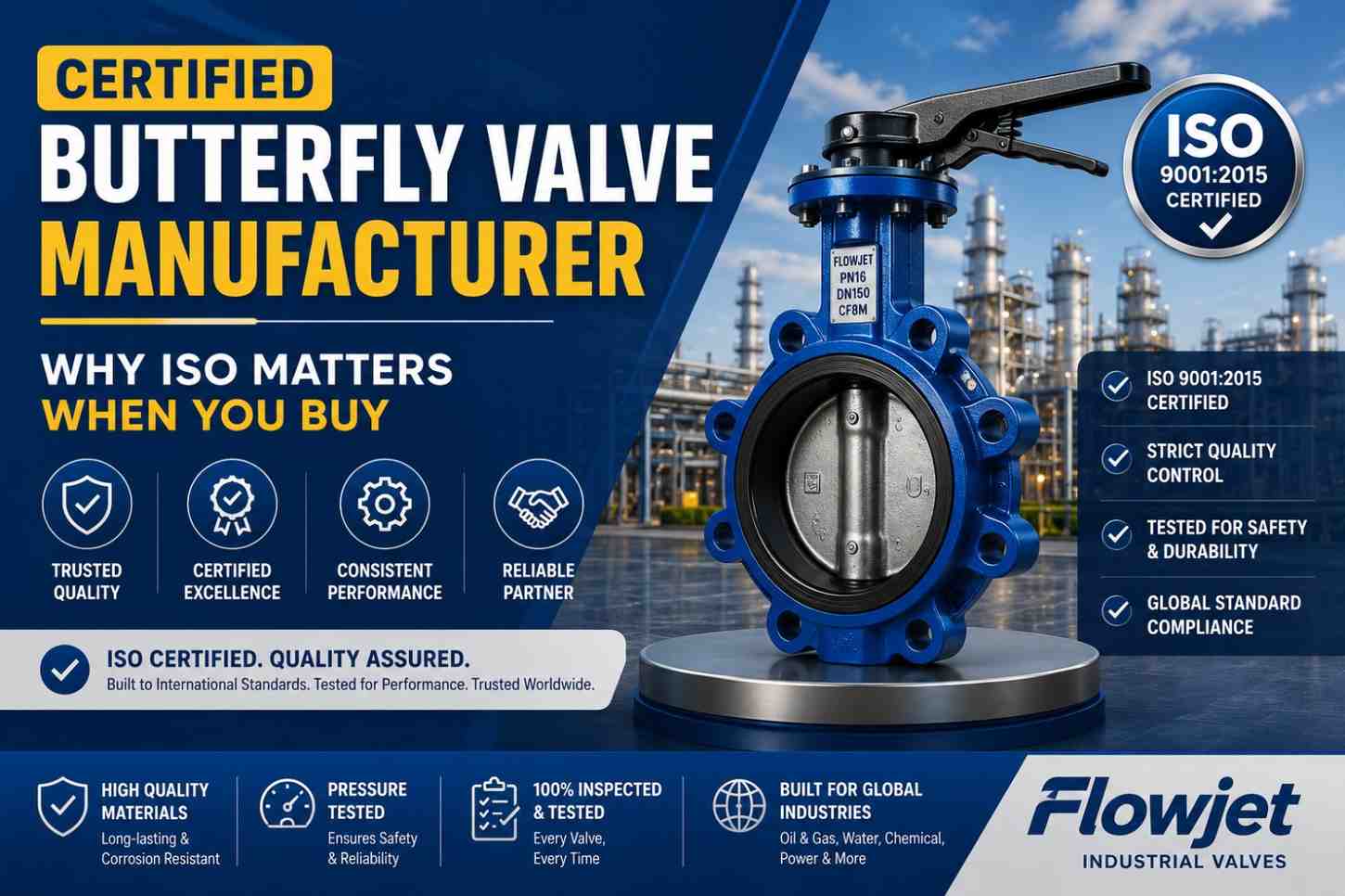
ISO 9001 is a quality management system standard. What that means practically is that a certified butterfly valve manufacturer has built documented, audited processes around how they design, manufacture, inspect, and deliver their products.
It means there’s a system for controlling raw material inputs — not just buying whatever’s available and assuming it matches the spec. It means there are defined inspection checkpoints during production, not just a final visual check before dispatch. It means non-conformances — when something doesn’t match specification — are recorded, investigated, and acted on rather than quietly set aside.
None of this happens automatically just because someone hangs an ISO certificate on their wall. The certification has to be earned through an external audit and renewed at regular intervals. Which is why the certificate date and the issuing body matter as much as whether one exists at all.
A butterfly valve manufacturer like Flowjet Valves that carries and maintains genuine ISO certification has gone through that process — and continues to go through it. For buyers, that’s not just reassuring language. It’s a verifiable fact.
The Documentation That ISO Certification Makes Possible
Here’s the practical side of this that buyers feel most directly.
When you order from a certified butterfly valve manufacturer, the documentation that comes with the valve — material test certificates, hydrostatic test records, seat leak test reports, dimensional inspection sign-offs — is produced as part of an audited quality system. It’s not assembled after the fact because someone remembered to ask for it. It’s generated as a standard output of the manufacturing process.
That distinction matters enormously when you’re handling project documentation for a large plant, managing vendor qualification for an industrial facility with regulatory requirements, or preparing for a third-party inspection.
An uncertified supplier can produce paperwork. But there’s no external verification that the paperwork reflects what actually happened during manufacture. With a certified butterfly valve manufacturer, the quality management system that generates that documentation is itself subject to audit. The records exist because the system requires them — not because a particular buyer happened to ask.
Flowjet Valves provides full test and material documentation with every order as a standard deliverable. MTCs, hydrostatic test certificates, and seat leak test reports — produced through an ISO-aligned quality system, not created on request after delivery.
ISO Certification and Valve Standards — Understanding the Difference
One confusion worth clearing up: ISO 9001 is a quality management standard, not a product performance standard. A butterfly valve that comes from an ISO-certified manufacturer isn’t automatically certified to API 609 or IS 13095 — those are separate product standards that define dimensional, pressure, and testing requirements for the valve itself.
What ISO 9001 certification tells you is that the manufacturer’s processes for making and testing that valve are controlled and documented. Whether the valve conforms to API 609 is a separate question — and a good one to ask.
The most rigorous butterfly valve manufacturers maintain both an ISO-certified quality management system and product conformance to relevant valve standards. Flowjet Valves operates this way — which is why their documentation package can speak to both the process quality and the product performance in a way that satisfies most industrial project requirements.
How to Check If a Certification Is Genuine
Not every ISO certificate is what it appears to be. In the Indian market — and in valve manufacturing globally — some suppliers display ISO logos on websites and brochures based on certificates that have expired, were issued by non-accredited bodies, or were obtained for a different scope of business than the manufacturing activity in question.
Before treating a certification as meaningful, it’s worth checking:
Who issued it? The certifying body should be accredited by a recognised national accreditation authority. In India, NABCB (National Accreditation Board for Certification Bodies) accreditation is the relevant standard.
When was it last renewed? ISO 9001 certification requires surveillance audits and recertification. An old certificate that hasn’t been renewed is not a current certification.
What scope does it cover? A certificate issued for trading activity doesn’t cover manufacturing processes. Make sure the certificate scope matches what you’re buying — manufactured valves, not sourced and resold ones.
Ask the butterfly valve manufacturer directly for their certificate number and issuing body, and verify it. A legitimate, certified manufacturer will have no problem with this. One who deflects or provides vague answers is telling you something important.
Why It Matters More Than Ever Right Now
Indian industry is becoming more audited, more regulated, and more closely scrutinised — both domestically and by international clients who source from Indian-based plants. The quality documentation requirements for chemical plants, pharmaceutical facilities, power projects, and export-oriented manufacturing have tightened considerably over the last few years.
In this environment, buying from a non-certified butterfly valve manufacturer isn’t just a quality risk. It’s an audit risk. A compliance risk. A risk that shows up not when the valve is installed but when an inspector asks to see the quality records, and they either don’t exist or can’t be verified.
Flowjet Valves has built its operations to meet these requirements—not just for the current project, but for the growing documentation and quality expectations that buyers across India’s process industries are navigating. That’s what choosing a certified butterfly valve manufacturer is really about. Not the badge. The system behind it.
Final Thought
ISO certification doesn’t make a butterfly valve manufacturer perfect. Nothing does. But it does mean there’s a documented, audited system in place that makes consistent quality more likely and traceable documentation a standard output rather than an afterthought.
For buyers who’ve spent time chasing certificates from suppliers who promised them after delivery, or who’ve had documentation fail during an inspection, the value of buying from a genuinely certified butterfly valve manufacturer isn’t abstract. It’s the difference between a smooth audit and a very uncomfortable week.
Flowjet Valves is that kind of manufacturer. The certification is current, the documentation system is real, and the quality records are produced because the system requires it — not because someone asked nicely.