
Steam service is the most common globe valve application in India. From massive thermal power generation setups and fertilizer complexes to process-heavy sugar mills, chemical plants, and textile processing units, steam drives industrial manufacturing. Because globe valves excel at both precise throttling and positive isolation, they act as the primary checkpoints across steam distribution networks.
However, running steam lines in India is not as simple as picking a generic valve from an international catalog. The presence of the Indian Boiler Regulations (IBR) completely reframes the engineering landscape. This strict regulatory framework creates a highly specialized, India-specific compliance system. Because international suppliers rarely understand or build for specific IBR parameters, global web platforms offer very little relevant competition. Sourcing a steam valve demands localized expertise in metallurgy, temperature-pressure boundaries, and statutory documentation.
This comprehensive technical guide breaks down the essential material choices, temperature boundaries, and IBR frameworks required to keep your steam lines running safely, efficiently, and in complete legal compliance.
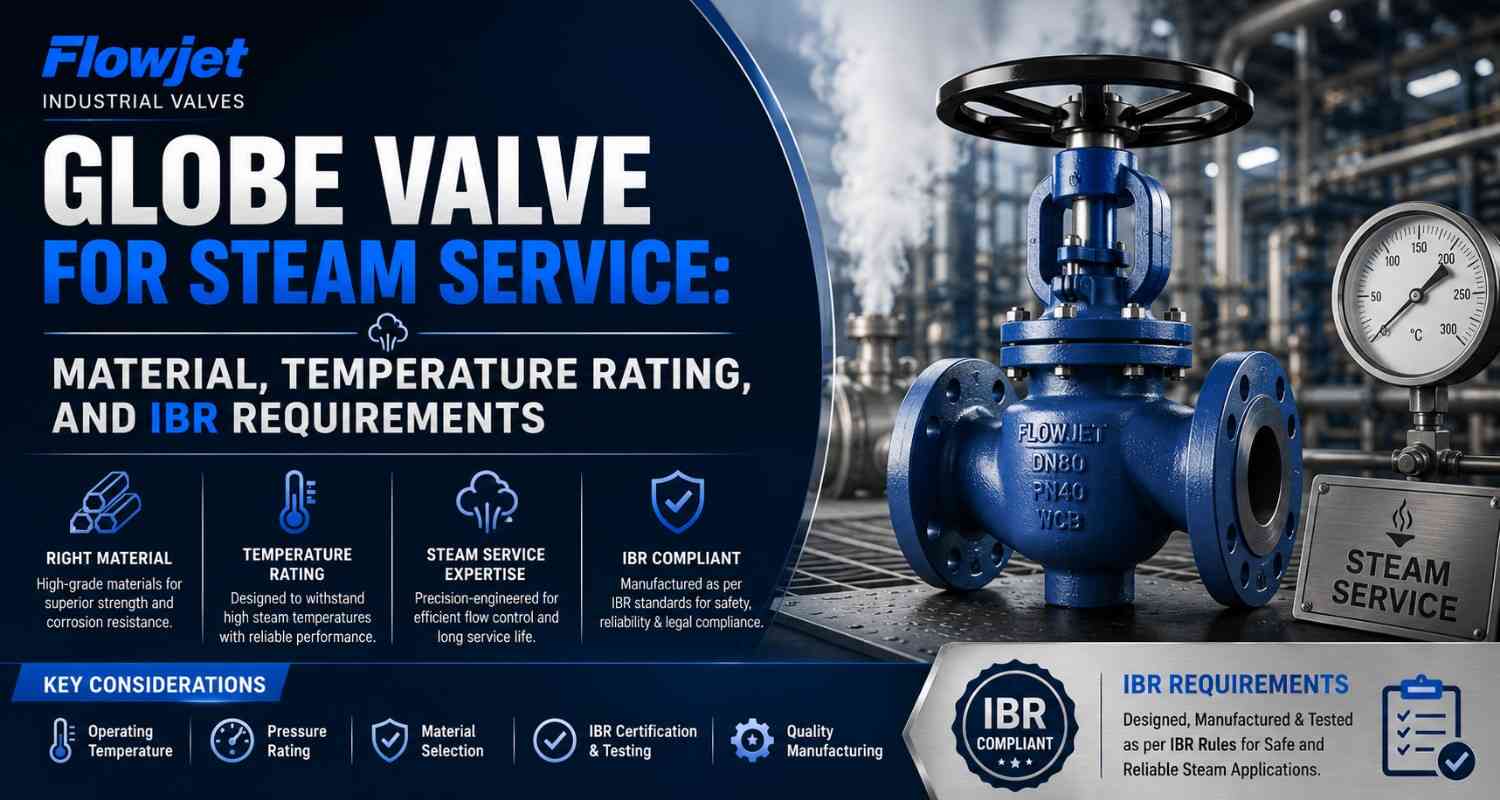
The IBR Mandate: Why Steam Isolation is India-Specific
Enacted under the Indian Boilers Act, the Indian Boiler Regulations (IBR 1950) govern the design, construction, and inspection of all pressure vessels and piping networks linked to steam generation. If your industrial facility operates a steam line where the boiler working pressure exceeds 3.5 kg/cm² (or where line sizes exceed 10 inches inside diameter at a pressure above 1.0 kg/cm²), the entire system falls directly under the jurisdiction of the state IBR authority. Even at lower parameters, any steam line operating above 0.5 kgf/cm² with temperatures exceeding 110°C triggers strict inspection laws.
This mandate changes your procurement workflow completely. You cannot simply buy an off-the-shelf valve and weld it into place. A legally compliant installation requires full material and manufacturing traceability:
- Form III-C (The Material Birth Certificate): This vital document certifies the exact chemical composition, tensile strengths, elongation properties, and heat-treatment cycles of the valve’s pressure-retaining castings or forgings.
- Form III-E (The Hydrostatic Test Record): This document proves that the completed valve was physically hydro-tested at a minimum of 1.5 times its design pressure rating in the direct presence of a certified, authorized IBR inspector.
Without these stamped forms matching the serial numbers etched onto the physical valve body, the state boiler inspector can halt your plant commissioning or refuse to renew your annual boiler license. This precise document trail is why generic foreign websites offer zero utility to Indian plant engineers.
Material Configurations for High-Temperature Steam Service
Steam changes properties rapidly depending on your position in the line. Superheated steam, saturated steam, and high-pressure boiler feedwater each degrade metals differently. Selecting the correct metallurgy is the difference between a facility running smoothly for a decade and an unplanned shutdown caused by body erosion or thermal fatigue.
Flowjet Valve configures globe valves across three primary material classes to match specific steam states:
1. Carbon Steel (ASTM A216 WCB / ASTM A105N)
The standard workhorse for main steam lines and medium-pressure boiler feed systems. Cast carbon steel (WCB) is generally utilized for flanged valves sized 2 inches and above, while forged carbon steel (A105N) handles small-bore, socket-weld auxiliary connections. Under IBR parameters, carbon steel works reliably for steam applications up to 250°C. Above this temperature threshold, prolonged exposure can cause graphite formation in carbon steel, weakening the outer shell.
2. Alloy Steel (ASTM A217 WC6 / WC9 & Forged F11 / F22)
When dealing with high-temperature superheated steam or high-pressure main steam lines in power generation, alloy steels are mandatory. Elements like Chromium and Molybdenum are added to give the steel immense creep resistance and prevent oxidation at extreme temperatures. Grade WC6 handles temperatures up to 540°C, while heavy-duty Grade WC9 handles superheated environments scaling up to 560°C or 600°C.
3. Stainless Steel (ASTM A351 CF8 / CF8M)
While carbon and alloy steels handle heavy utility power loops, stainless steel globe valves are critical for clean steam networks. Industries like pharmaceuticals, food processing, and hospital sterilization skids require pure steam lines to avoid particulate rust contamination. Grade CF8M (316 SS) provides excellent resistance against volatile condensates and corrosive chemical clean-in-place (CIP) cycles.
Understanding Pressure-Temperature Ratings
A steam globe valve does not operate on a fixed pressure limit. As line temperatures spike, the maximum allowable working pressure of the metal drops significantly. This relationship is managed under the ASME B16.34 framework.
For instance, an ASME Class 300 carbon steel valve might hold a maximum pressure of roughly 51 bar at ambient conditions. However, if your steam lines are pushing temperatures up to 300°C, that same Class 300 valve’s safe operating envelope drops below 38 bar. Sourcing managers must design for the *maximum peak temperature* of the system rather than just the base operating pressure.
| Valve Material Grade | Common Steam State | IBR Practical Temperature Limit |
|---|---|---|
| Cast Carbon Steel (A216 WCB) | Saturated Steam / Feedwater Line | Up to 250°C (Standard Limits) |
| Alloy Steel (A217 WC6 / F11) | Medium Superheated Steam | Up to 540°C |
| Alloy Steel (A217 WC9 / F22) | High-Temp Superheated Steam | Up to 560°C – 600°C |
| Stainless Steel (A351 CF8M) | High-Purity Process Clean Steam | Up to 400°C (Process Specific) |
Critical Mechanical Trim Details for Steam Service
Steam is a violent fluid medium. High-velocity gas flows can trigger rapid erosion, wiredrawing (where wire-thin steam leaks cut channel grooves across sealing faces), and heavy cavitation. Regular general-purpose valves fail inside steam lines within a few weeks. Your procurement specifications must include heavy industrial features:
Stellite Hard-Faced Trims
The sealing plug and the seat ring must utilize a Stellite hardfacing overlay (typically Stellite #6). Stellite is a cobalt-base alloy that retains massive structural hardness even when glowing under high thermal loads. This layer resists the high-impact scouring action of steam particles, preventing seat bypassing.
Flexible Graphite Stem Packing
Standard PTFE (Teflon) packing rings degrade or melt if temperature levels cross 200°C. For steam systems, die-formed flexible graphite rings paired with braided graphite anti-extrusion rings are mandatory. Graphite handles severe temperature spikes smoothly while ensuring low friction against the rising stem, keeping fugitive emissions locked down tight.
OS&Y (Outside Screw & Yoke) Bonnet Layout
Avoid internal stem designs for steam pipelines. An OS&Y globe valve keeps the critical stem threads outside the pressure boundary, up away from direct fluid exposure. This keeps the line fluid from washing away thread lubricants, protecting your operators against stem binding and keeping the valve easy to turn under heavy load conditions.
Sourcing Blueprint: Evaluating an IBR Certified Vendor
When you are preparing an industrial Request for Quote (RFQ) for steam valves, use this exact validation framework to eliminate uncertified middlemen:
- Verify active foundry qualifications: Ensure the manufacturing plant operates with valid, active authorizations from the Central Boilers Board or the local state directorate of boilers.
- Cross-check stamp markings: True IBR valves must feature a physical inspector stamp, the manufacturer’s heat number, and the IBR serial log physically punched directly into the casting shell.
- Demand original Form III documents: Do not accept un-countersigned photocopies. Insist on original Form III-C and Form III-E sheets stamped by the official licensing authority.
- Match face-to-face standards: Ensure dimensions align perfectly with ASME B16.10 or BS 2080 guidelines to fit your existing piping spool dimensions cleanly.
Frequently Asked Questions (FAQs)
What exact steam line parameters mandate a certified IBR globe valve in India?
Any steam line where the boiler working pressure exceeds 3.5 kg/cm², or line sizes that scale past 10 inches inside diameter with pressures at 1.0 kg/cm² or higher, falls under IBR. Additionally, systems operating above 0.5 kgf/cm² with steam temperatures passing 110°C require fully certified IBR components to operate legally.
Why do foreign websites offer very little information regarding IBR regulations?
Because IBR is a statutory legal act specific to India. International valve manufacturers build standard products to global codes like ASME or EN, but they do not maintain dedicated pipelines for physical, third-party audits by Indian State Boiler Inspectors. This makes IBR compliance a uniquely localized process.
Can I use a standard carbon steel valve for superheated steam loops?
No. Standard carbon steel (A216 WCB) has a practical working limit around 250°C under standard steam service. Superheated steam easily passes 350°C to 500°C, which causes carbon steel to experience graphite formation and rapid degradation. You must step up to alloy steel grades like ASTM A217 WC6 or WC9 for superheated loops.
What is the core purpose of a Form III-C and Form III-E document?
Form III-C certifies the chemical and physical structural properties of the raw valve castings, ensuring zero material flaws. Form III-E acts as the pressure testing certificate, documenting that an official inspector witnessed the valve hold a hydrostatic body test at 1.5 times its rated pressure without showing a single pinpoint leak.
How does a globe valve prevent the common issue of steam “wiredrawing”?
Wiredrawing happens when high-velocity steam cuts deep channels through soft valve components. High-quality globe valves prevent this damage by adding heavy Stellite cobalt alloy overlays onto both the seating surfaces and the plug faces. This layer gives the valve structural wear protection against fluid scouring.
Conclusion: Ensuring Operational and Legal Security
Managing steam lines requires zero compromises on technical accuracy. By pairing robust metallurgy with precise ASME pressure-temperature ratings and active IBR certification forms, plant engineers can run high-pressure loops safely while remaining fully protected against compliance issues.
By executing strict CNC tolerances, providing robust Stellite hardfacing overlays, and delivering full Form III documentation paths, Flowjet Valve ensures your steam infrastructure stays completely secure, legally sound, and optimized for long-term production runs.
Are you looking to replace aging steam valves or expanding your boiler piping infrastructure? Connect with the engineering helpdesk at Flowjet Valve today to receive optimized technical datasheets and fully certified IBR project quotes.