
Introduction
Most procurement teams ordering butterfly valves choose between wafer and lug type at some point. The question usually comes up during a plant layout review or a piping specification meeting, and the answer isn’t always as obvious as it should be.
Both types use the same disc-and-seat mechanism. Both seal the same way. Both come in the same body materials, the same seat options, the same actuation configurations. From a flow control perspective, they’re identical.
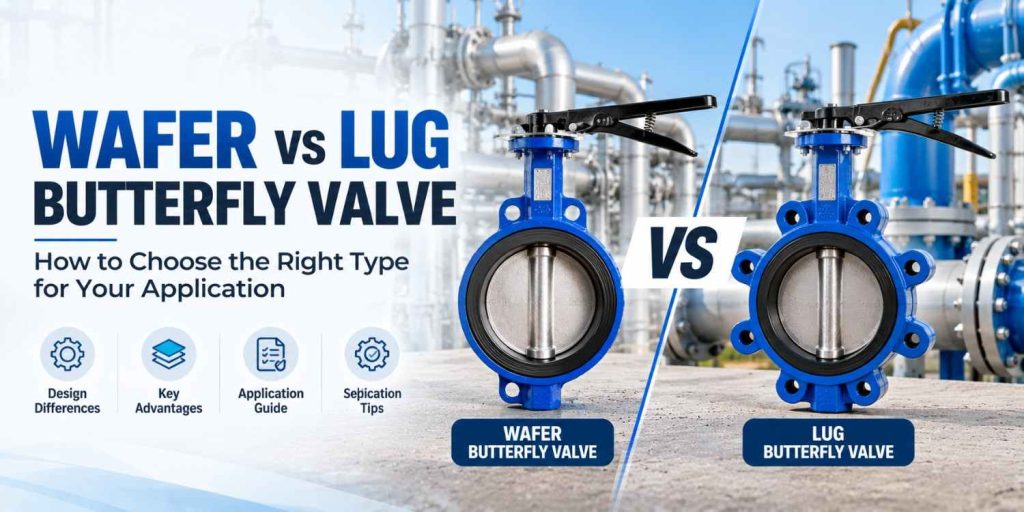
The difference is entirely in how they connect to the pipeline — and that difference has real consequences for installation, maintenance, and what happens when you need to disconnect a section of pipe.
Getting this choice wrong isn’t catastrophic. It’s just more expensive than it needs to be. A lug valve in a mid-line application that never needs dead-end capability costs more than it should. A wafer valve in a dead-end or maintenance-intensive application causes problems during every shutdown — or worse, during an emergency isolation.
This guide explains the real-world difference between wafer and lug butterfly valves across four criteria: installation, maintenance, pipeline layout, and service conditions. Flowjet Valve manufactures both types from its Ahmedabad facility, supplying process plants across Gujarat and India. The goal here is to help you choose the right one.
Part 1 — Installation: What Actually Happens on Site
Wafer Type — How It Installs
A wafer butterfly valve is the simpler installation of the two. The valve body is slim — often 40 to 60 mm face-to-face even at large diameters — and it sits in the gap between two pipe flanges. Long through-bolts pass through the upstream flange, through the valve body, and thread into the downstream flange (or pass through both flanges with nuts on the far end).
The key point: the wafer valve has no threads of its own. It’s held in place entirely by the bolt tension between the two flanges. Alignment is handled by the bolts themselves and by a centering boss or face groove that seats against the flange faces.
In practice, installation is fast. Two fitters, a set of through-bolts, a gasket on each face, and the valve is in place. For large diameter lines — DN200 and above — the lightweight of a wafer body compared to a lug body is a genuine handling advantage.
The limitation becomes obvious when you try to remove one side: take out the downstream flange and the valve has nothing to hold it. It falls, or the upstream line has to be depressurised first.
Lug Type — How It Installs
A lug butterfly valve has threaded inserts — the lugs — built into the body at each bolt position. These lugs allow bolts from the upstream flange to thread directly into the valve body, and bolts from the downstream flange to do the same, independently of each other.
Installation takes slightly longer. The upstream flange bolts in first, the valve is seated, then the downstream flange bolts in. Each side is independent. The trade-off for this extra installation step is the ability to remove either flange side without disturbing the other — which matters enormously in certain pipeline layouts.
Lug valves are heavier than equivalent wafer valves, particularly in larger sizes. The lugs add material and weight. For elevated or vertical installations where the valve body needs to support its own weight without relying on the pipe flanges, the lug body’s rigidity is an advantage, not just a complication.
Flowjet Valve’s lug-type butterfly valves are manufactured with drilled and tapped lug inserts in ductile iron or cast iron bodies, with bolt patterns to ASME B16.5 and API 609 dimensional standards. Both face-to-face dimensions and bolt patterns are verified against the flange standard at each production stage.
Part 2 — Maintenance: What Happens at Turnaround
This is where the wafer vs. lug decision has the most direct operational impact, and where getting it wrong creates recurring frustration.
The Wafer Valve Maintenance Reality
A wafer butterfly valve in a mid-line position — between two permanent flanges with connections on both sides — is easy to service. When the seat needs replacing or the stem seal needs repacking, you unbolt both flanges together, pull the valve, carry out the work or swap to a replacement valve, and bolt it back in. Total process downtime is driven by how long the line takes to depressurise, drain, and re-commission — not by the valve removal itself.
The problem appears when maintenance requires downstream pipe removal. If the downstream spool needs to come off—for an expansion, a nozzle modification, or maintenance on downstream equipment—the wafer valve comes off with it. You can’t leave the valve in place and remove only the downstream section.
For plants where this kind of section-by-section maintenance is common, every wafer valve in those sections becomes a minor project during turnaround. Not a major one. But a recurring minor one.
The Lug Valve Maintenance Advantage
A lug butterfly valve eliminates this problem. Because each flange bolts independently into the valve body, the downstream flange can be removed while the upstream connection remains bolted and live. The valve itself stays in place, holding the upstream line sealed. The downstream spool comes off, the maintenance work happens, and the spool goes back on.
This is what “dead-end service capability” actually means in maintenance practice. It’s not just about emergency isolation—it’s about how every planned shutdown on that section works, every turnaround, and every downstream equipment change.
Plants that have a mix of wafer and lug butterfly valves — wafer in permanent mid-line positions, lug at maintenance break points and section ends — have made this decision deliberately. Plants that specified wafer valves everywhere because they were cheaper find out the difference at the first major turnaround.
Flowjet Valve recommends lug type for any butterfly valve position that a process engineer identifies as a potential maintenance break point — even if dead-end service isn’t planned. The additional cost is small at procurement time. The recurring saving in turnaround time is real.
Part 3 — Pipeline Layout: Where Each Type Belongs
Mid-Line Permanent Installation — Wafer is Right
Isolation valves on utility headers — cooling water, compressed air, instrument air, steam condensate — that sit between permanent flanges and are rarely, if ever, required to support dead-end service are exactly the right application for wafer butterfly valves. Lower cost, lighter weight, simpler installation.
Process plant headers where section isolation is by upstream block valves — not by removing downstream pipe — also suit wafer valves. If the pipeline on both sides of the valve remains in place during any foreseeable maintenance scenario, a wafer valve is the appropriate choice.
Dead-End and Terminal Positions—Lug Is Required
Any valve at the end of a pipeline — a tank connection, a pump suction header, a vessel nozzle isolation — should be a lug type. These positions will see situations where the downstream connection is removed: for vessel inspection, pump maintenance, or piping modifications. A wafer valve in these positions creates either a safety problem (depressurise the whole line just to disconnect one spool) or an operational one (the valve can’t hold the line while downstream work happens).
Flowjet Valve’s lug-type butterfly valves are regularly specified for exactly these applications across Gujarat’s process plants — tank connections in chemical plants at Vatva and Ankleshwar, pump isolation on water treatment facilities in Ahmedabad and Gandhinagar, vessel nozzle valves in pharmaceutical plants near Ahmedabad.
Vertical Pipeline Sections
On vertical pipe runs, a wafer butterfly valve’s weight is supported by the surrounding flanges and bolts. In standard installations this is fine. In large diameter vertical installations — DN400 and above — the weight and any vibration from flow can create bending load on the flange-bolt-valve assembly. Lug type valves, with direct threaded body connections on each flange, handle this loading more predictably.
Fire Fighting Systems
Fire fighting system valves in industrial plants — on sprinkler headers, deluge system mains, hydrant connections — are almost always specified as lug type. These valves must be capable of isolating sections of the system for maintenance while adjacent sections remain pressurised and ready. A wafer valve cannot provide this; a lug valve can.
Part 4 — Service Conditions: Does the Type Affect Performance?
In most service conditions, wafer and lug butterfly valves with the same body material, seat material, and disc configuration perform identically. The valve type doesn’t affect flow coefficient, pressure drop, or seat sealing performance. It only affects how the valve interfaces with the piping system.
There are a few service-specific considerations worth noting.
Higher pressure service: At PN16 and above, the bolt loading on a wafer valve — which depends on the flange gaskets and through-bolt tension to keep the valve in position — is adequate for most standard installations. For very high pressure or systems with significant vibration, lug type provides a more secure body connection.
Flanged connections in ASME Class 300 and above: Most standard wafer butterfly valves are rated to Class 150. For Class 300 and above, flanged butterfly valve designs (double flanged, with the valve body having integral raised-face flanges) are more common. Lug type butterfly valves extend somewhat further into the Class 150/PN16 range before flanged designs become more appropriate.
Vacuum service: If the system can go under vacuum — some chemical process lines, vacuum distillation, some water treatment conditions — the valve must be specified for vacuum as well as pressure. Lug type connections are more secure under vacuum loading because each flange is independently bolted to the body.
Chemical compatibility: No difference between wafer and lug. Seat and body material selection for chemical service applies equally to both types. Flowjet Valve’s butterfly valves are available in both wafer and lug configurations with EPDM, NBR, PTFE, and Viton seat options for chemical plant, pharmaceutical, and water treatment service.
Quick Reference — Which Type to Choose
| Situation | Wafer | Lug |
|---|---|---|
| Mid-line permanent installation | ✅ Correct choice | Over-specified |
| Dead-end / terminal pipe position | ❌ Not suitable | ✅ Required |
| Fire fighting systems | ❌ Not suitable | ✅ Required |
| Downstream pipe needs regular removal | ❌ Problematic | ✅ Correct choice |
| Pump suction / discharge isolation | Consider | ✅ Recommended |
| Utility headers (cooling water, air) | ✅ Standard choice | Optional |
| Large diameter vertical runs | Adequate | ✅ Preferred |
| Vacuum service | With care | ✅ More secure |
| Cost-sensitive mid-line utility | ✅ More economical | Higher cost |
Flowjet Valve — Both Types, From One Manufacturer
Flowjet Valve manufactures wafer and lug type butterfly valves at its GIDC Kathwada, Ahmedabad facility. Both types are available across the same material range: cast iron and ductile iron bodies, EPDM, NBR, PTFE, and Viton seat options, with SS 304 and SS 316 bodies for stainless service. Sizes run from DN50 to DN600 in standard configurations.
For process plant projects where the right answer is a mix — wafer for permanent mid-line service, lug at break points and terminal positions — Flowjet Valve supplies both types under the same documentation, the same quality process, and the same delivery schedule. That matters for EPC contractors and plant procurement teams who need consistent valve quality across a project BOM rather than managing two separate supplier relationships for essentially the same product.
Technical support for piping layout reviews, valve positioning recommendations, and actuator sizing is available directly from Flowjet Valve’s Ahmedabad team.
Summary
The wafer vs lug decision comes down to one question: does this valve position ever need to support one-sided disconnection?
If the answer is no — both flanges are permanent, mid-line, no dead-end service requirement — a wafer butterfly valve is the correct and more economical choice.
If the answer is yes — or even maybe — a lug type butterfly valve is the right specification. The cost difference at procurement time is real but small. The operational difference during maintenance or a shutdown scenario is significant.
Flowjet Valve’s technical team can review your piping layout and help identify which positions need lug type and where wafer type is adequate. For Gujarat plants in Ahmedabad, Surat, Vadodara, Rajkot, Ankleshwar, and surrounding industrial areas, that conversation is a phone call away.
Q: What is the difference between a wafer type and a lug type butterfly valve? A wafer butterfly valve sits between two pipe flanges and is clamped in place by through-bolts that pass through both flanges and the valve body. It has no independent threaded connections. A lug butterfly valve has threaded inserts (lugs) cast into the body at the bolt hole positions, allowing it to be bolted to each flange independently. This means a lug type can be installed as a pipeline end point or for dead-end service where one side of the pipeline may be disconnected.
Q: When should I use a lug butterfly valve instead of a wafer butterfly valve? Use a lug butterfly valve when: (1) the valve is at the end of a pipeline where one flange connection may need to be removed; (2) the system requires dead-end service — closing the valve and removing downstream piping while the upstream line remains live; (3) installation or maintenance requires each side of the pipeline to be managed independently; (4) vertical pipeline sections where gravity loading on a wafer valve would stress the bolt-flange connection. For mid-line installation between two permanent flanges with no dead-end requirement, a wafer valve is sufficient and more economical.
Q: Can a wafer butterfly valve be used for dead-end service? No. A wafer butterfly valve depends on both flanges for structural support — it cannot hold pressure from one side alone with the other flange removed. For any application where the downstream flange may be disconnected while the valve remains under pressure, a lug type butterfly valve with thread-into-body bolts is required