Choosing a butterfly valve manufacturer sounds simple on paper. You need valves, they make valves, you place an order. Done.
Except it’s not done. Not really.
Because three months into the project, the seat starts leaking. Or the material certificate the auditor asked for doesn’t exist. Or the lead time that was promised at the time of order quietly doubled. And now you’re on-site trying to explain to the plant manager why a valve that was supposed to be a solved problem has become the most talked-about item in the weekly review meeting.
This happens more often than it should. And in almost every case, the root cause isn’t the valve itself — it’s that the manufacturer behind it wasn’t evaluated carefully enough before the purchase order was signed.
This guide walks you through exactly what to look for when choosing a butterfly valve manufacturer for your plant — whether you’re sourcing for a new project, replacing ageing stock, or trying to qualify a long-term supplier relationship.
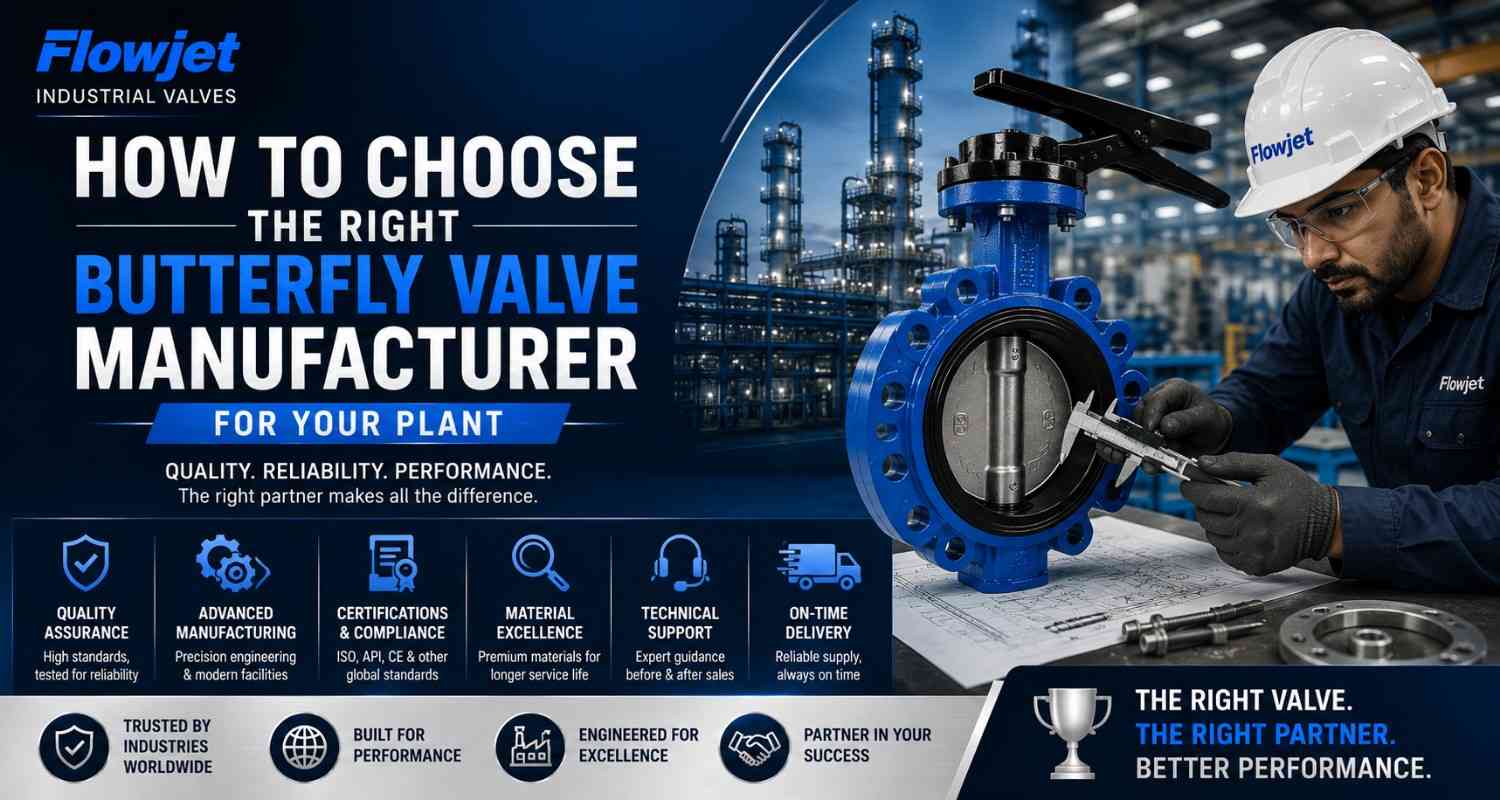
1. Verify They Actually Manufacture — Not Just Assemble
This is the first and most important question to answer before anything else.
The Indian valve market has grown significantly over the last decade. With that growth has come a large number of suppliers who describe themselves as the best butterfly valve manufacturers but are, in reality, trading operations. They source finished or semi-finished components — valve bodies from one foundry, discs from another, seats from a third — and assemble them under their own brand name.
There is nothing automatically wrong with some degree of outsourcing. But a supplier who has no in-house machining, no casting capability, and no direct control over component quality is not a manufacturer in any meaningful sense. When a dimensional issue shows up, or a material doesn’t match the certificate, or a non-standard configuration is needed, they have no real ability to fix it — because they don’t control the process.
When evaluating a butterfly valve manufacturer, ask directly:
- Do you machine the valve body in-house?
- Where are the disc and seat components produced?
- Can I visit your manufacturing facility?
A genuine manufacturer answers these questions without hesitation. A trading company either deflects or provides vague answers.
Flowjet Valve, based in Ahmedabad, operates as a true butterfly valve manufacturer with in-house machining, assembly, and testing — which is why plant engineers who’ve visited the facility tend to come away with a much clearer picture of what they’re actually buying.
2. Check Material Range and Compatibility
Not every butterfly valve fits every application. The valve that works perfectly on a water supply line may fail quickly on a chemical dosing system or a high-temperature steam auxiliary line. Material selection — body, disc, seat liner, and stem seal — needs to match the actual process conditions.
A butterfly valve manufacturer worth working with should be able to offer:
Body materials:
- Cast iron — general water and mild service
- Ductile iron — higher mechanical loads, moderate corrosion
- Stainless steel SS 304 / SS 316 — corrosive chemicals, food, pharma
- Carbon steel — oil, gas, and general process service
Seat and liner materials:
- EPDM — water, mild acids and alkalis
- NBR — oils, fuels, hydrocarbons
- PTFE — aggressive chemicals, broad chemical resistance
- Viton — high temperature chemical service
If a manufacturer only stocks one or two material combinations, they’re built for a narrow application range. That’s fine if your plant happens to fall within it. But if your requirements span multiple service types — cooling water, chemical dosing, and process steam, for example — you need a butterfly valve manufacturer who can cover that range without asking you to deal with three separate suppliers.
Flowjet Valve supplies butterfly valves in all major body and seat material combinations, with technical support to help match the right configuration to each specific application across Gujarat’s diverse process industries.
3. Ask for Documentation — Before You Commit
Material test certificates. Hydrostatic test records. Seat leak test reports. Dimensional inspection reports.
These are not nice-to-have documents. For most industrial plants — particularly in chemical, pharmaceutical, and power sectors — they’re mandatory for vendor qualification audits, ISO compliance, and internal quality records.
Ask for sample documentation from a recent production batch before placing your first order. A butterfly valve manufacturer who handles documentation properly will send it quickly and cleanly. One who isn’t used to providing it will either delay, send incomplete records, or quietly skip the request and hope you don’t follow up.
Flowjet Valve provides complete test and material documentation as a standard part of every supply — not as an added service or an afterthought.
4. Evaluate Their Product Range for Your Future Needs
Plants change. Processes expand. A valve that was specified for water service gets repurposed for mild chemical duty. A manual valve needs to be replaced with an actuated version for a new automation project.
A butterfly valve manufacturer with a broad product range — wafer type, lug type, double flanged, high performance, concentric, eccentric, manual and actuated configurations — can grow with your requirements without forcing you to qualify a new supplier every time something changes.
Flowjet Valve’s product range covers:
- Wafer type butterfly valves — 50mm to 600mm, standard pipeline service
- Lug type butterfly valves — dead-end service, fire fighting and water systems
- Double flanged butterfly valves — large diameter, heavy-duty applications
- High performance butterfly valves — double and triple eccentric for higher pressure
- Pneumatic actuated butterfly valves — process automation and remote operation
- Electric actuated butterfly valves — precise control and automation-ready configurations
This range means that whether you’re specifying for a new greenfield project or replacing a single valve in an existing plant, Flowjet Valve can supply from a single source across multiple valve types.
5. Consider Location and After-Sales Support
This one is underestimated more often than any of the others.
When a valve fails — or when a process change means a seat material needs to be upgraded, or when a project needs ten more valves urgently before a commissioning deadline — proximity matters enormously.
A butterfly valve manufacturer located within reasonable distance can deliver faster, can be visited when a technical discussion is needed face-to-face, can supply spare seats and discs from stock rather than from a warehouse three states away, and has a genuine reputational stake in keeping Gujarat’s industrial buyers satisfied.
Flowjet Valve’s location in Ahmedabad places it at the centre of Gujarat’s industrial corridor — within accessible distance of chemical plants in Vatva and Naroda, water infrastructure projects across the state, pharmaceutical units around Ahmedabad, and process industry clients throughout Gujarat and western India.
That proximity translates to faster standard delivery, accessible spare parts, and after-sales support that’s a phone call rather than a long email chain.
6. Look for Industry-Specific Experience
A butterfly valve manufacturer who has supplied predominantly to water treatment projects may not have the material knowledge or testing experience relevant to a pharmaceutical or chemical plant requirement. Industry-specific experience matters — not because it’s impossible to serve multiple sectors, but because a manufacturer who’s familiar with your industry’s standards, documentation requirements, and failure modes will ask better questions and make fewer mistakes.
Flowjet Valve has supplied butterfly valves across chemical processing, water and wastewater treatment, pharmaceutical manufacturing, power plant auxiliaries, fire fighting systems, and HVAC applications. That cross-industry experience means fewer surprises at the specification stage and more relevant technical guidance during product selection.
7. Check for Relevant Certifications
ISO 9001 certification is the baseline for any serious butterfly valve manufacturer — it signals that quality management processes are in place and audited. Depending on your sector, additional certifications or compliance with specific standards may matter:
- API 609 — butterfly valves for general service
- EN 593 — industrial butterfly valves European standard
- IS 13095 — Indian standard for butterfly valves
- API 598 — valve testing and inspection
Before finalising a supplier, check which standards their valves conform to and whether they can provide test reports to those standards. This becomes important at project handover, regulatory inspections, and client audits.
Why Flowjet Valve Is the Right Choice for Your Plant
Flowjet Valve brings together everything a plant engineer or procurement manager actually needs from a butterfly valve manufacturer:
✅ In-house manufacturing with direct quality control
✅ Full material range — cast iron to stainless steel, EPDM to PTFE
✅ Complete documentation — MTCs, hydrostatic and seat leak test reports
✅ Wide product range — wafer, lug, flanged, high-performance, actuated
✅ Gujarat-based with fast delivery across India
✅ Cross-industry experience in chemicals, water treatment, pharma, power
✅ Technical team available for material selection and specification support
Whether you’re qualifying a new supplier for a long-term project or sourcing urgently for a maintenance requirement, Flowjet Valve is set up to respond quickly, supply reliably, and support your plant beyond the delivery note.